A glimpse of PCC's library Technology program and the work of library technicians:
Tampilkan postingan dengan label Library 105. Tampilkan semua postingan
Tampilkan postingan dengan label Library 105. Tampilkan semua postingan
Senin, 26 Maret 2012

Senin, 09 Januari 2012
Locating the Law Handbook for Non-Librarians
I love a freebie that comes from good stock. The Southern California Association of Law Libraries has a new edition of the Locating the Laws Handbook. If you are interesting in working in a law library or need to find a law source quickly this might be the publication you have been seeking in the stacks.
There is much goodness to be found here. Chapter 3 has a guide to conducting a legal information search and interview techniques. This is a section of the handbook that talks about the legal information interview:
The handbook is a Adobe PDF document. You can view by chapter or you can download the entire handbook and read it on your computer or with you favorite tablet or e-reader.
You definitely want this on your virtual resource shelf.
 |
| 5th Edition of Locating the Law, A Handbook for Non-Law Librarians |
There is much goodness to be found here. Chapter 3 has a guide to conducting a legal information search and interview techniques. This is a section of the handbook that talks about the legal information interview:
Regardless of how the question is phrased, the user is ultimately asking what law or laws apply to his or her situation. Your first task, as in any reference interview, is to analyze the information provided in order to identify the relevant facts and to weed out the irrelevant. To determine the relevant facts, you will usually need to ask additional questions. At this point, it is appropriate to briefly address concerns about the unauthorized practice of law.
Librarians conducting a reference interview should not be afraid to ask questions of someone seeking legal information. Asking questions in order to make recommendations about appropriate legal resources to consult does not constitute giving legal advice.
The handbook is a Adobe PDF document. You can view by chapter or you can download the entire handbook and read it on your computer or with you favorite tablet or e-reader.
You definitely want this on your virtual resource shelf.
Sabtu, 28 Agustus 2010
The Dewey Blog - All Dewey All The Time
I miss getting a daily or weekly dose of library news, education and all around juice. Here is a goody I should visit more than I do, 025.431 The Dewey Blog.

Yes, life in classification. As a side benefit you can observe how to construct Dewey numbers. How would you classify a salad? Need to know how to classify a book about Star Trek? What about Water Lilies?
Not only can you see Dewey classification in action, you can also check out the various Dewey communities both national and international.
If you are taking a classification class and you need real world examples of constructing Dewey numbers this is the place.
Yes, life in classification. As a side benefit you can observe how to construct Dewey numbers. How would you classify a salad? Need to know how to classify a book about Star Trek? What about Water Lilies?
Not only can you see Dewey classification in action, you can also check out the various Dewey communities both national and international.
If you are taking a classification class and you need real world examples of constructing Dewey numbers this is the place.
Senin, 17 Agustus 2009
Collecta - Real Time Search of Blogs, Tweets and Videos
Collecta searches in real time for your topic. It includes Blogs and Twitter text into your search.
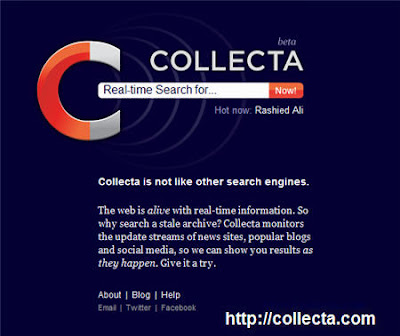
Collecta will continue to look for your topic until you tell it to stop by deselecting the search box. I didn't understand why it kept updating the search after I finished it or went on to another topic. It was like the little engine that could.

The Preview panel allows you to see the content and you can click to visit the source. Here is the neat part; under search options you see the following:
 Searching for comments is interesting because I have found good links and resources that way. I also like the video search aspect but I would like to choose different video distribution sources like Daily Motion, Blip.tv and other similar sites.
This Is A Keeper
Collecta is still in Beta so when I performed a search on "library classification systems" I got results from programing languages, game players terminology and other not obvious classification connections, in addition to library blogs.
Currently there is no way that I could find to restrict the search area; for example I can't tell Collecta to search only Wordpress blogs or only blogs that have "library" in the title.
At this point I think this is a good alternative for Google Blog Search and it can be used as a supplement to other search engines.
Collecta will continue to look for your topic until you tell it to stop by deselecting the search box. I didn't understand why it kept updating the search after I finished it or went on to another topic. It was like the little engine that could.
The Preview panel allows you to see the content and you can click to visit the source. Here is the neat part; under search options you see the following:
Searching for comments is interesting because I have found good links and resources that way. I also like the video search aspect but I would like to choose different video distribution sources like Daily Motion, Blip.tv and other similar sites.This Is A Keeper
Collecta is still in Beta so when I performed a search on "library classification systems" I got results from programing languages, game players terminology and other not obvious classification connections, in addition to library blogs.
Currently there is no way that I could find to restrict the search area; for example I can't tell Collecta to search only Wordpress blogs or only blogs that have "library" in the title.
At this point I think this is a good alternative for Google Blog Search and it can be used as a supplement to other search engines.
Minggu, 28 Juni 2009
English Short Title Catalogue at the British Library
At this section of the British Library website you can locate titles for books published between 1473 and 1800. If the material was published in the UK or its possessions, Colonial America or any place else on the planet, and it was printed in English, it very well might be listed in this database.
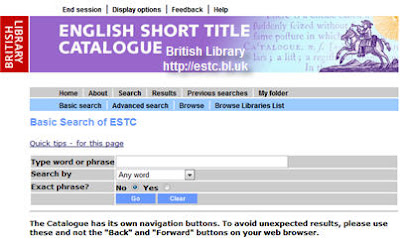 Now short title does not refer to the length of the actual name of the book. As you can see from the example below, titles could be quiet descriptive:

My understanding is that it refers to limited or special publications produced quickly. I'm thinking like pamphlets, broadsheets and the early equivalents of instant publishing.
As you can see, you can view the records in a variety of formats such as a three line summary listing, full MARC tags, or which institution has the actual document.
This is a good resource if you are researching ephemeral publications that give a sense of time and place.
It is also valuable if you want to brush up on your MARC skills if it has been long time since you have sweated a MARC code. Check it out.
Now short title does not refer to the length of the actual name of the book. As you can see from the example below, titles could be quiet descriptive:My understanding is that it refers to limited or special publications produced quickly. I'm thinking like pamphlets, broadsheets and the early equivalents of instant publishing.
As you can see, you can view the records in a variety of formats such as a three line summary listing, full MARC tags, or which institution has the actual document.
This is a good resource if you are researching ephemeral publications that give a sense of time and place.
It is also valuable if you want to brush up on your MARC skills if it has been long time since you have sweated a MARC code. Check it out.
Kamis, 25 September 2008
University of the West Library Chinese Cataloging Internship
The University of the West Library has an internship opportunity for students who are interested on learning Chinese cataloging. Internships for credit require enrollment in LIB 106 Field Practice and 6 additional units at PCC.
If you are interested please contact:
Ling-Ling Kuo, Librarian, University of the West Library
1409 Walnut Grove Ave, Rosemead, CA
(626) 571-8811 x. 135
If you are interested please contact:
Ling-Ling Kuo, Librarian, University of the West Library
1409 Walnut Grove Ave, Rosemead, CA
(626) 571-8811 x. 135
Kamis, 05 Juni 2008
More 105 Cataloging Help - Kinda, Sorta
Saturday. Friday is before Saturday and Saturday is the day of the Cataloging Final. To those about to take the test we salute you and are glad we are on the other side of it.
I know I was pitiful. I was mumbling AACR2 left and right. That blankety blank punctuation drove me nuts. I still can see my classmates. Binders full of notes and marked up AACR2. We came prepared but most of us had our doubts of seeing daylight ever again. People shaking their heads in despair, others kept the mantra going, "It is ok, it will be alright."
But I have to tell you, that stuff comes in handy in ways you do not expect. I am very glad that I took the class. But I was sweating bullets each and every week.
The Short Version:
In addition to the other cataloging links that you can find by looking for the word cataloging in the sidebar, I have a few more hopefully helpful study tips.
There is a OSU Power Point presentation that is a review of AACR2 Chapter 12. If you can't view or download PPT's you can look at an HTML generated copy of Chapter 12.
I was thinking that there might be a few resources at Google Books that could be helpful. Like for example the meaning of the word "imprint"? The Dictionary of Library and Information Science might be of interest to you, especially page 351.
This is a partial preview. The whole book is not available. But you might find what you need to help you understand what bibliographic control is which may or may not be on page 69.
I did find some library specific glossaries, AACR2 Definition of Terms, An AACR2 record description list and Abbreviations for Place of Publication
Good luck and deep breaths.
I know I was pitiful. I was mumbling AACR2 left and right. That blankety blank punctuation drove me nuts. I still can see my classmates. Binders full of notes and marked up AACR2. We came prepared but most of us had our doubts of seeing daylight ever again. People shaking their heads in despair, others kept the mantra going, "It is ok, it will be alright."
But I have to tell you, that stuff comes in handy in ways you do not expect. I am very glad that I took the class. But I was sweating bullets each and every week.
The Short Version:
- Review Your Notes, Exam Questions and AACR2
- Tell your loved ones to bug off - this is serious business.
- Get some sleep, eat a great dinner and sleep with your (paper) notebook.
In addition to the other cataloging links that you can find by looking for the word cataloging in the sidebar, I have a few more hopefully helpful study tips.
There is a OSU Power Point presentation that is a review of AACR2 Chapter 12. If you can't view or download PPT's you can look at an HTML generated copy of Chapter 12.
I was thinking that there might be a few resources at Google Books that could be helpful. Like for example the meaning of the word "imprint"? The Dictionary of Library and Information Science might be of interest to you, especially page 351.
This is a partial preview. The whole book is not available. But you might find what you need to help you understand what bibliographic control is which may or may not be on page 69.
I did find some library specific glossaries, AACR2 Definition of Terms, An AACR2 record description list and Abbreviations for Place of Publication
Good luck and deep breaths.
Minggu, 04 Mei 2008
Cataloging SOS - Cataloging Reference Books
AACR2 is many things but easy reading it is not. It is not too late to find more humane help in understanding cataloging and classification.
Libraries Unlimited has a number of books and workbooks on cataloging/classification.

I think this was the one that we flipped through at the California Library Convention in Long Beach.
Closer to home, Cataloging & Classification for Library Technicians is on the third floor of the library - 025.3 K 4, 2001 or if somebody beats you to it you can order at Amazon.com

Descriptive Cataloging, this one will be good for both 105A and 105B You can find it at Amazon.com or Powell's Books

Remember, if you are short on cash don't hesitate to do the WorldCat thing, somebody, somewhere has got these books.
Libraries Unlimited has a number of books and workbooks on cataloging/classification.
Closer to home, Cataloging & Classification for Library Technicians is on the third floor of the library - 025.3 K 4, 2001 or if somebody beats you to it you can order at Amazon.com
Descriptive Cataloging, this one will be good for both 105A and 105B You can find it at Amazon.com or Powell's Books
Remember, if you are short on cash don't hesitate to do the WorldCat thing, somebody, somewhere has got these books.
Cataloging SOS - Tag of the Month Club
Yes indeed, it is that time of year when Library 105 students go into a cold sweat. Ten or more weeks of cataloging goodness will do that to you. It is not just learning how to write and understand the concepts of MARC, it is that pesky punctuation that just kills the majority of the class.

I know, one doggone period in the wrong place and boom, there goes your grade. No worries. There is help. Check out Follett Software Company's Tag of the Month.
It goes into a description of what the tag is, the reason for the tag and most important how to punctuate the sucker.
Now if there is a discrepancy between what the Tag of the Month suggests and what Dawn says the punctuation of the tag is don't be a dope, go with Dawn! But at least this will help you to understand the syntax of the tag in question. Don't forget about spacing, that counts too but this will help you remember what goes where and why.
Background Information for Non-Library Folks
For those visiting from other parts of the blogosphere we ask for your sympathy and good wishes for every library cataloging student in the world. There is a whole bunch of technical stuff that happens long before you get your hot little hands on a book or library material.
One of the skills those of us who are interested in library work have to know (or should know) is Machine-Readable Cataloging or MARC. It is a process where the material, let say a book is described by a number of data points such as the name of the author, the type of material, its physical dimensions (if any) the publisher and a bunch of other stuff.
All of this happens in the background so when you step up to the terminal or log on from home you put in what you know about a book and bada-bing, you get results based on your search request.
There is no artificial intelligence at work - this is organic human brain power generated data. Why? Because every book, DVD, CD, Sheet Music, photograph, mp3 file, video or other materials is unique. Way too many variables for a (current) software program to account for automatic entry. The picture above is showing an example of a MARC 300 tag which defines a material by its physical description depending on what kind of object it is. .
Minggu, 13 April 2008
Music Cataloging Resources
You walk into a room. There are hundreds of boxes of vinyl recordings before you. You open the first box and see this 45 record:

Originally uploaded by me1vinsparks
How do you catalog this record? You've taken the cataloging class but that was primarily for books. The concepts are the same but you want to review the resources for cataloging music.
AACR2 Resources
Training Materials for Music Cataloging. In 1995 Ian Fairclough put together this list of cataloging study tips that can be reviewed. It gives you the sections of AACR2 to review and study for music cataloging. Please understand that this is an old list and does not address music formats such as MP3, FLAC or DRM issues.
From the University of Buffalo another option is to take a look at the Sound Recording Workshop Handouts created by Jay Weitz. It seems to be a Power Point presentation that was converted to images but it is really helpful in focusing on the areas you will need to extract information from and how to do it.
MARC Resources
Penn State University Sound Recording MARC Fixed Field Cheat Sheet - This will give you an idea of how to find or prep music MARC codes. This cheat sheet is for the Unicom system, you would have to adapt it to Voyager or other software programs.
Yale University Library has a Voyager based Physical Description Codes for Sound Recordings
that you can use to make sure that you are on the correct path in Voyager. You should also view the Fixed Fields for Sound Recording Chart.
Other Resources:
Music Catalogers ListServ (MOUG) - if you really want to know more about music cataloging, OCLC issues and the day to day realities of quantifying that grove.
Authority Tools for Audiovisual and Music Catalogers: An Annotated List of Useful Resources
Music Cataloging At Yale - Long list of websites and resources for a wide variety of music cataloging needs.
Just for Fun (Kinda)
Jason Poole created a video about his informal survey with librarians on how they classified music. It is music and text, no vocals. There is also a brief introduction to the ANSCR music classification system.
Minggu, 10 Februari 2008
University of LaVern Law School - Cataloging Assistant
The University of La Verne has an opening for a Cataloging Assistant in the College of Law Library. The position is responsible for creation & maintenance of bibliographic records and serials control.
Primary duties for this position include:
You can obtain a MS Word or Adobe PDF application by visiting the Classified Application Procedures page. To apply, please send a complete application in Word or PDF format to: jobs@ulv.edu, or mail to Human Resources, University of La Verne, 1950 Third Street, La Verne, CA 91750. Or you may FAX your application to: (909) 392-2791.
Primary duties for this position include:
- assisting the Cataloger with copy cataloging of the Law Library’s materials in all formats
- maintaining serial holdings including the creation of MARC holdings, title changes, etc.
- performing routine database maintenance on the library’s bibliographic holdings
- placing library’s holdings in OCLC’s Union List and maintaining the database according to current cataloging standards and practices and other duties as required.
You can obtain a MS Word or Adobe PDF application by visiting the Classified Application Procedures page. To apply, please send a complete application in Word or PDF format to: jobs@ulv.edu, or mail to Human Resources, University of La Verne, 1950 Third Street, La Verne, CA 91750. Or you may FAX your application to: (909) 392-2791.
Minggu, 28 Oktober 2007
Library of Congress Classifiction Tutorials
Yes, learning the Library of Congress Classification system is not for the faint of heart. Fortunately there are some online resources that you can use to get a handle on how things are done in LC land.
The LC Classification system is a subject based classification system using alphabets and numbers to create subdivisions of a subject.
Classification Number Anatomy
Dennison University has a visual page that shows the construction of an LC number.
Another place to check is Tarleton State University Library has a clear tutorial page that explains how the call numbers are built.
If you have the current version of Java running you can access a Java based slide show on how the numbers function in the real world. First thing you will learn is that "Nothing comes before something" and the second thing is "single letters come before double letters." There is a quiz at the end to test your comprehension.
Theory Based Tutorials
Tulane University Howard Tilton LC Informal Notes page talks about the features of LC, how it was constructed and some of the quirk inherent in the system.
Colorado State University goes into a bit more detail on how the call numbers are constructed. The first section has information on the classification scheme and the second section describes how to find the book on the shelf.
University of Michigan Libraries Understanding Library of Congress Call Numbers combines the anatomy approach with an explanation of how to read the number. This is a downloadabled .pdf document.
And finally thanks to Lisa The Librarian's blog there is a complete demo tutorial on shelving and reading LC numbers at the LibraryU website. Look for the link "Demo" on the left side of the screen.
Of course you should visit the Library of Congress Classification Outline page where you can download specific sections of the classification system and observe how the system is constructed and spend time exploring Classification Web.
The LC Classification system is a subject based classification system using alphabets and numbers to create subdivisions of a subject.
Classification Number Anatomy
Dennison University has a visual page that shows the construction of an LC number.
Another place to check is Tarleton State University Library has a clear tutorial page that explains how the call numbers are built.
If you have the current version of Java running you can access a Java based slide show on how the numbers function in the real world. First thing you will learn is that "Nothing comes before something" and the second thing is "single letters come before double letters." There is a quiz at the end to test your comprehension.
Theory Based Tutorials
Tulane University Howard Tilton LC Informal Notes page talks about the features of LC, how it was constructed and some of the quirk inherent in the system.
Colorado State University goes into a bit more detail on how the call numbers are constructed. The first section has information on the classification scheme and the second section describes how to find the book on the shelf.
University of Michigan Libraries Understanding Library of Congress Call Numbers combines the anatomy approach with an explanation of how to read the number. This is a downloadabled .pdf document.
And finally thanks to Lisa The Librarian's blog there is a complete demo tutorial on shelving and reading LC numbers at the LibraryU website. Look for the link "Demo" on the left side of the screen.
Of course you should visit the Library of Congress Classification Outline page where you can download specific sections of the classification system and observe how the system is constructed and spend time exploring Classification Web.
Minggu, 14 Oktober 2007
Dewey Decimal System - All Dewey All The Time
If you find yourself working in a public library chances are good that it will use the Dewey Decimal System. Melvil Dewey is certainly represented on the web and in the blogosphere.
The following places of interest are a quick look at some of the resources available to help you learn and understand about the classification system. If you are taking Library 105B you are hip deep in the Dewey so hopefully I can dig out additional resources for the class.
The official Dewey site Online Learning Computer Center (OCLC) contain a gateway to the world of classification. You can download a copy of Introduction of Dewey Decimal Classification. In 37 pages it will give you the history, the classification schedules and the beginning steps on how to determine a subject, Notation, field of study and working with schedules and tables.
You will also want to check out the glossary of Dewey terms. Students in certain LT classes have access to Web Dewey but if you would like to get a head start on how to use the Web Dewey feature you can view a Power Point tutorial.
Outside of OCLC another place you want to visit is the Dewey Blog, edited by Johnathan Furner and the DDC team. If you can think it there is (or will be) a Dewey number for it. The blog represents life as viewed by the DDC. One of the entry that had me blinking was the classification of the toys and lead problems that have been in the news.
They go through the process of how this topic has been classified and what they do when there is not an exact match in the classification system. It is also a good opportunity to observe how a DDC "built" numbers are constructed.
Not every public library has Dewey, in fact there are a few that stopped using Dewey numbers such as the one in Arizona. They will arrange books by topic instead.
This has generated a lot of posts. Daniel DeStefano isn't crazy about the idea. A Library By Any Other name blog suggest that one of the problems with patrons finding books is that there isn't the right kind of signs or visual cues that would make it clear that where to find the history book.
Not all folks hate the idea of pitching Dewey - some folks like Shelly from A View From Here mention that maybe there could be a merger between the bookstore model and the traditional library classification systems.
The following places of interest are a quick look at some of the resources available to help you learn and understand about the classification system. If you are taking Library 105B you are hip deep in the Dewey so hopefully I can dig out additional resources for the class.
The official Dewey site Online Learning Computer Center (OCLC) contain a gateway to the world of classification. You can download a copy of Introduction of Dewey Decimal Classification. In 37 pages it will give you the history, the classification schedules and the beginning steps on how to determine a subject, Notation, field of study and working with schedules and tables.
You will also want to check out the glossary of Dewey terms. Students in certain LT classes have access to Web Dewey but if you would like to get a head start on how to use the Web Dewey feature you can view a Power Point tutorial.
Outside of OCLC another place you want to visit is the Dewey Blog, edited by Johnathan Furner and the DDC team. If you can think it there is (or will be) a Dewey number for it. The blog represents life as viewed by the DDC. One of the entry that had me blinking was the classification of the toys and lead problems that have been in the news.
They go through the process of how this topic has been classified and what they do when there is not an exact match in the classification system. It is also a good opportunity to observe how a DDC "built" numbers are constructed.
Not every public library has Dewey, in fact there are a few that stopped using Dewey numbers such as the one in Arizona. They will arrange books by topic instead.
This has generated a lot of posts. Daniel DeStefano isn't crazy about the idea. A Library By Any Other name blog suggest that one of the problems with patrons finding books is that there isn't the right kind of signs or visual cues that would make it clear that where to find the history book.
Not all folks hate the idea of pitching Dewey - some folks like Shelly from A View From Here mention that maybe there could be a merger between the bookstore model and the traditional library classification systems.
Jumat, 15 Juni 2007
Cataloging Help for the Hopeless - Library 105A Assistance
Ok, there is hope. It is just that before an exam I see the darkness before the dawn.
We'll do fine. I think. So this is just a recap and additional sources to check out and compare what we have learned and what we might have to back fill on for the exam.
We'll do fine. I think. So this is just a recap and additional sources to check out and compare what we have learned and what we might have to back fill on for the exam.
- Authority Tutorial http://www.lib.usm.edu/%7Etechserv/pdc/auth_tutorial/index.htm
- Bibliographic Formats and Standard http://www.oclc.org/bibformats/en/
- Catalogblog http://www.catalogablog.blogspot.com
- Cataloger Calculator - type in a word, select the search options and it will give you the correct abbreviation for the field. http://calculate.alptown.com
- Cataloger's Reference Shelf http://www.itsmarc.com/crs/CRS0000.htm
- Catalogers Toolbox http://staff.library.mun.ca/staff/toolbox
- Connexion Client Tutorials http://www.oclc.org/support/training/connexion/client/tutorial/default.htm
- Internet Library for Librarians Cataloging Section, this has links to various web pages dealing with cataloging http://www.itcompany.com/inforetriever/cat.htm
- Information Professionals Glossary http://www.sir.arizona.edu/resources/glossary.html
- Library of Congress Authorities Records Search link - http://authorities.loc.gov
- MARC Tag of the Month - an explanation of each tag and examples http://www.fsc.follett.com/clientsupport/community/tagofthemonth
- MARC Punctuation Cheat Sheet http://staffweb.lib.washington.edu/monos/catdocs/punctuationcheatsheet.html
- Monographic Cataloging Cheat Sheet is a review of what should be focused on in a particular section but it doesn't tell necessarily how to do it. http://www.slc.bc.ca/cheats/mono.htm
- Note Order and MARC tags http://staff.library.mun.ca/staff/toolbox/
- OCLC Authorities User Guide http://www.oclc.org/support/documentation/worldcat/authorities/userguide
- UCLA Cataloging Reference Shelf http://unitproj.library.ucla.edu/cataloging/refshelf/index.cfm
- Web World of Authority Control http://net.lib.byu.edu/~catalog/catalogwebsite/authority/index.htm
- Yale Cataloging Tools and Resources http://www.library.yale.edu/cataloging/tools.htm
Kamis, 29 Maret 2007
Resources to Help Learn About Web 2.0
For our online discussion group we have to learn what Web 2.0 means and apply its implications to library service. This is an attempt to display some of the audio and video explanations.
This Web 2.0 video gives a great overview of what the buzz is all about. For those in Library 105 you will recognize some of the terms that we have been exposed to in the discussion group.
What is Web 2.0? Andi Gutmans of Zend gives an explanation. You can visit the page at http://zdnet.com.com/1606-2-6103931.html or, if your browser permits, click the YouTube version below:
For a truly cosmic yet lyrical explanation you should view Michael Wesch's video. You can view a decent copy at http://www.somewhatfrank.com/2007/02/video_explains_.html
My suggestion is to view the other videos first and then experience what he has to say about the topic.
Other resources:
http://planetweb20.com/
http://www.readwriteweb.com/bestof.php
http://www.somewhatfrank.com/web_20/index.html
This Web 2.0 video gives a great overview of what the buzz is all about. For those in Library 105 you will recognize some of the terms that we have been exposed to in the discussion group.
What is Web 2.0? Andi Gutmans of Zend gives an explanation. You can visit the page at http://zdnet.com.com/1606-2-6103931.html or, if your browser permits, click the YouTube version below:
For a truly cosmic yet lyrical explanation you should view Michael Wesch's video. You can view a decent copy at http://www.somewhatfrank.com/2007/02/video_explains_.html
My suggestion is to view the other videos first and then experience what he has to say about the topic.
Other resources:
http://planetweb20.com/
http://www.readwriteweb.com/bestof.php
http://www.somewhatfrank.com/web_20/index.html
Senin, 13 November 2006
Liszen - A Library Blog Search Engine
When I am searching for library specific blogs I general use Google Blog Search http://blogsearch.google.com It helps but I still have to wade through a bunch of junk to find the types of blogs that I am searching for.

Liszen makes it easier to find library based blogs. You just type in the search term and it will only look at a subset of library specific blogs. What is interesting about Liszen is that it is built using Google's search engine architecture.
To simplify, users get to make your own search engine with the power of Google behind you. So if you wanted to create a search engine that looked for natural science web sites you can construct it with help from Google.
I don't want to mislead you. You need a certain level of technical skill to pull this off. For more information on how to get started visit http://www.google.com/coop
In the meantime I'm diving into http://www.liszen.com
To simplify, users get to make your own search engine with the power of Google behind you. So if you wanted to create a search engine that looked for natural science web sites you can construct it with help from Google.
I don't want to mislead you. You need a certain level of technical skill to pull this off. For more information on how to get started visit http://www.google.com/coop
In the meantime I'm diving into http://www.liszen.com
Langganan:
Postingan (Atom)