One cannot travel through library history without hearing about Thomas Jefferson's valuable contributions. Last summer, I had the amazing experience of finally visiting the Library of Congress. Viewing the reconstruction of Thomas Jefferson's Library which is an on-going exhibit was only a small part of this visit. So imagine my delight when I found out that this past Saturday, February 11th at the 45th California International Antiquarian Book Fair, there would be a talk on "Jefferson's Legacy: Building the Rare Book Collections at the Library of Congress" given by LofC Chief of the Rare Book and Collections Division, Mark Dimunation, which was sponsored by the Bibliographical Society of America. I envy this man's position as he gets to work daily with this collection while searching for those items that were destroyed in the fire of 1851.
Dimunation showed slides of various items from Jefferson's Library. Jefferson divided his library into three categories, Memory, Reason and Imagination, which he interpreted as History, Philosophy and Fine Arts which he further divided into forty-four chapters. While can view the exhibit online, it is not quite the same as seeing it in person though I would recommend both. One can take all the time he wants viewing more details of each item online. One can even send "postcards" to others of various items by registering first.
Even though the seminar's focus was to be on Jefferson's Library, Dimunation also showed representations of LofC's Bible Collection and the Abraham Lincoln Bicentennial Exhibition. $100,000 is a still lot of money to us but imagine how much that was back in 1865? While I could not locate the very same poster that was shown, you can take a glimpse at this similar one.
Even if you cannot get to the Library of Congress in person any time soon, you can still take a virtual tour. One of the advantages to this feature is getting to access past exhibits as well. So take a spin on a cost-free trip to the Library of Congress right at the tip of your fingers.
Tampilkan postingan dengan label Library 101. Tampilkan semua postingan
Tampilkan postingan dengan label Library 101. Tampilkan semua postingan
Rabu, 15 Februari 2012

Kamis, 29 September 2011
Banned Books Week 2011

With this week more than half way over, you may think it's too late to do anything for Banned Books Week. It's never too late. Pick up a book or watch a movie based on a banned book.
Earlier this week, I was in Chicago for a couple of days and discovered at the bookstore that the Harold Washington Library Center of Chicago was hosting an event called, "Books on the Chopping Block" which entailed the City Lit Theater Company reading the top 10 most frequently challenged books of 2010. What was so amazing about these ten titles is that they are all young adult and children's books. Imagine that! Why there is so much fear about allowing teens and kids to view the world as it really is through fiction is beyond me? But alas, there is fear that these books will instill the wrong ideas in to children's heads. That is a sad premise to hold onto. The one good thing about a book being challenged and/or banned is that just makes that particular book all the more appealing. I am sure the censors never see it that way.
I have many favorite books that have made it to the banned and/or challenged list. My top two favorites are by Judy Blume, "Forever" and "Are you there, God? It's me, Margaret." I cannot imagine having grown-up without having Judy Blume books in my life. Did anyone try to stop me from reading either of these books? Actually, my mother made me put "Forever" back on the shelf deeming it not appropriate reading material ever. Well that made me even more determined to read the book, so I decided to see if the library would tell me I could not check out that book as well. The very next day after school, I found the book right where I had reluctantly put it back and checked it out without a problem. I was thrilled that to discover that the library wouldn't be trying to censor what I read.
I'd love to hear what your favorite banned and/or challenged book that you have read or even a movie or play based on one.
Jumat, 14 Agustus 2009
Social Networking - Part I
About 10 years ago, I was having a discussion with a friend who doubted that online social networking would ever catch on. And actually, I didn't realize myself just how huge this phenomenon would later become as I had tried to convince him that people would change their tune later. Who would have thought he'd belong to Facebook before me?
Anyone who knows me has had the experience of dealing with some resistance from me through the new waves of technology over the years. The first time I came in contact with a computer was ironically at the library at CSULA when I was a student in 1984. They started out with one or two catalog terminals back then. If you were to walk in there now, it seems as if the computers have taken over the library. Who would have thought?
Shortly after my first introduction to computers, I found out that the small company I was working for then was taking that forward step into technology as we all got our own computers. No more tedious work on an electric typewriter for me!
For 15 years, my viewpoint was that computers were about making work more efficient. Not about meeting and connecting with people online. The whole idea of going online just seemed bizarre to me when a boyfriend tried to explain how it worked. Time and time again over a year's period, he tried to convince me to just try it. The only thing I was willing to do on his home computer was play solitaire. Finally, one day I decided to take that next first step in the land of technology- the Internet.
My first experience involved going into an online chat room which for a hard-of-hearing person was a dream come true. I could understand what every single person said in my open and private conversations in that online room without having to ask anyone to repeat themselves. If I had known what a life-altering experience it would be, I would have tried it out much sooner. I will admit I did become quite addicted to going online to chat to people all over the world. I do still have some cherished friendships from that time even though I no longer have gone to chat rooms for quite some years now.
Back then, if you admitted that you had met someone from online in person, people would often look at you like you were crazy. What sane person would do that? Was it even safe? That was the the just tip of the iceberg. Online dating sites were fairly new but starting to become popular slowly in the late 90s. I have taken that route before and have met some interesting people but never found love there as some have.
For me, it seems technology has taken me full circle as I once viewed it as a way to achieve your work more efficiently. Social networking now has become a visible and viable way to live your life. From myspace to Facebook, Twitter and so much more, it can include every facet of your life- from school to work to hobbies and more. It still astounds me the explosion of technology in what seems a rather short time in history.
My next installments are going to cover various social networking sites as I attempt to familiarize myself with more of them. I've had quite a few myspace accounts that I've opened and deleted until I stuck with the current one I have. In the last year, I've had countless requests to open a Facebook account. I just roll my eyes as I say, "I don't need something else to worry about online." I already have multiple e-mail addresses, a myspace page and a Twitter account I had opened up back in December and forgotten about till I was recently reminded of when a couple of friends added me. That doesn't even include the message boards and blogs I hardly visit any more due to a lack of time or forgetfulness. So whether you're a seasoned social networker or a newbie, follow my journey in becoming more knowledgeable.
Anyone who knows me has had the experience of dealing with some resistance from me through the new waves of technology over the years. The first time I came in contact with a computer was ironically at the library at CSULA when I was a student in 1984. They started out with one or two catalog terminals back then. If you were to walk in there now, it seems as if the computers have taken over the library. Who would have thought?
Shortly after my first introduction to computers, I found out that the small company I was working for then was taking that forward step into technology as we all got our own computers. No more tedious work on an electric typewriter for me!
For 15 years, my viewpoint was that computers were about making work more efficient. Not about meeting and connecting with people online. The whole idea of going online just seemed bizarre to me when a boyfriend tried to explain how it worked. Time and time again over a year's period, he tried to convince me to just try it. The only thing I was willing to do on his home computer was play solitaire. Finally, one day I decided to take that next first step in the land of technology- the Internet.
My first experience involved going into an online chat room which for a hard-of-hearing person was a dream come true. I could understand what every single person said in my open and private conversations in that online room without having to ask anyone to repeat themselves. If I had known what a life-altering experience it would be, I would have tried it out much sooner. I will admit I did become quite addicted to going online to chat to people all over the world. I do still have some cherished friendships from that time even though I no longer have gone to chat rooms for quite some years now.
Back then, if you admitted that you had met someone from online in person, people would often look at you like you were crazy. What sane person would do that? Was it even safe? That was the the just tip of the iceberg. Online dating sites were fairly new but starting to become popular slowly in the late 90s. I have taken that route before and have met some interesting people but never found love there as some have.
For me, it seems technology has taken me full circle as I once viewed it as a way to achieve your work more efficiently. Social networking now has become a visible and viable way to live your life. From myspace to Facebook, Twitter and so much more, it can include every facet of your life- from school to work to hobbies and more. It still astounds me the explosion of technology in what seems a rather short time in history.
My next installments are going to cover various social networking sites as I attempt to familiarize myself with more of them. I've had quite a few myspace accounts that I've opened and deleted until I stuck with the current one I have. In the last year, I've had countless requests to open a Facebook account. I just roll my eyes as I say, "I don't need something else to worry about online." I already have multiple e-mail addresses, a myspace page and a Twitter account I had opened up back in December and forgotten about till I was recently reminded of when a couple of friends added me. That doesn't even include the message boards and blogs I hardly visit any more due to a lack of time or forgetfulness. So whether you're a seasoned social networker or a newbie, follow my journey in becoming more knowledgeable.
Senin, 10 Agustus 2009
Ohio University Libraries - The Business Blog
I do try to keep my other interests and avocations off of the PCC Libtech blog but sometimes my life has other plans. While looking for video blogs I discovered another librarian who uses video in his site, Library Voice.com.
Chad Boeninger and writes about how technology in libraries can and should be of service to the patrons.

Chad is also in charge at the Ohio University Library Business blog where he locates content and material to help students and faculty make sense of these financially constraining times.
One of the challenges that Chad has to face is working with reduced acquisition fund budget. He has to cut books and subscriptions in order to slash $85,000+ out of the budget.
For those of you who have taken Library 101, Library 103 and Library 104 this is the working example of not only weeding materials but also facing the fact that you no longer own a current copy of the information; it is online in a subscription based system.
That may work when the library system can pay the vendor subscription fees but if money get tight you not only loose current information but access to past history and materials as well.
It is a tough balance. In a prior video, Chad goes step by step on the reasons for canceling certain materials and invites the faculty for input.
This is a good opportunity to get insight on an academic library and real world decisions that have to be be made. As I go deeper into the blog there are screencasts that explain research skills, consumer trends, the current marketplace and those things that would support the goals of the library.
I hope that by visiting these sites it will give context to the impact that budget cuts have on libraries and patrons. It is also a good place to get an insight on how to be of technological service to staff and patron.
Chad Boeninger and writes about how technology in libraries can and should be of service to the patrons.
Chad is also in charge at the Ohio University Library Business blog where he locates content and material to help students and faculty make sense of these financially constraining times.
One of the challenges that Chad has to face is working with reduced acquisition fund budget. He has to cut books and subscriptions in order to slash $85,000+ out of the budget.
For those of you who have taken Library 101, Library 103 and Library 104 this is the working example of not only weeding materials but also facing the fact that you no longer own a current copy of the information; it is online in a subscription based system.
That may work when the library system can pay the vendor subscription fees but if money get tight you not only loose current information but access to past history and materials as well.
It is a tough balance. In a prior video, Chad goes step by step on the reasons for canceling certain materials and invites the faculty for input.
This is a good opportunity to get insight on an academic library and real world decisions that have to be be made. As I go deeper into the blog there are screencasts that explain research skills, consumer trends, the current marketplace and those things that would support the goals of the library.
I hope that by visiting these sites it will give context to the impact that budget cuts have on libraries and patrons. It is also a good place to get an insight on how to be of technological service to staff and patron.
Kamis, 26 Maret 2009
Ohio State University Cartoon Library and Museum
I do like cartoons. I like libraries. In a perfect world there would be a cartoon library. Fortunately, even in an imperfect world there is a cartoon library. The Ohio State University Cartoon Library and Museum has been in existence since 1977.

According the the About Us page its mission is to:
There is a database to locate a certain artist or work:
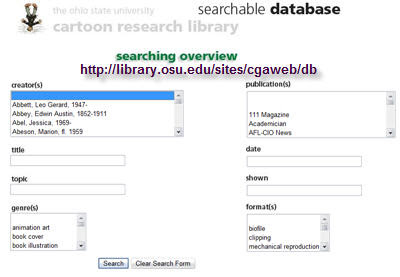 You can search by creator, type of publication, type of market, the name of the cartoon or the format that the cartoon or graphic novel was published. Not all comics are represented but you do get to search for some of the early work in the topic.
You can view some of the collection online in galleries and albums:
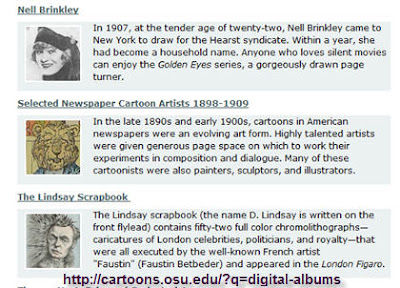
This is a great example of a specialized library and a library/museum partnerships.
According the the About Us page its mission is to:
...develop a comprehensive research collection documenting American printed cartoon art, to organize the materials, and to provide access to these resources.
The scope of the collection includes:
- editorial cartoons
- comic strips
- comic books
- graphic novels
- sports cartoons
- magazine cartoons
There is a database to locate a certain artist or work:
You can search by creator, type of publication, type of market, the name of the cartoon or the format that the cartoon or graphic novel was published. Not all comics are represented but you do get to search for some of the early work in the topic.You can view some of the collection online in galleries and albums:
This is a great example of a specialized library and a library/museum partnerships.
Senin, 16 Februari 2009
Intellectual Freedom and Teens Video at YALSA Blog
Over at the Young Adult Library Services Association (YALSA) blog there is a video about how intellectual challenges affect teens.
Joseph Wilk of the Carnegie Library of Pittsburgh and Katie, a teenager who blogs at the library talk about how challenges to a book or material can affect teen patrons.
There are a few minor quibble with the video. It is not captioned. In this video, it would have really helped because it was hard to hear Katie. I had to crank up the volume to hear the good points that Katie made concerning access to book with subjects such as drinking, drugs and sexual activity.
One of the points that she made was that if a book is written for teens and it contains the kind of things that teens might encounter who are you protecting by challenging the book?
To be fair, this was the first video. I hope the YALSA blog continues to try video blogging. It can be a great way to engage their population about how the library can serve their needs better.
Joseph Wilk of the Carnegie Library of Pittsburgh and Katie, a teenager who blogs at the library talk about how challenges to a book or material can affect teen patrons.
There are a few minor quibble with the video. It is not captioned. In this video, it would have really helped because it was hard to hear Katie. I had to crank up the volume to hear the good points that Katie made concerning access to book with subjects such as drinking, drugs and sexual activity.
One of the points that she made was that if a book is written for teens and it contains the kind of things that teens might encounter who are you protecting by challenging the book?
To be fair, this was the first video. I hope the YALSA blog continues to try video blogging. It can be a great way to engage their population about how the library can serve their needs better.
Selasa, 20 Januari 2009
Reflections - Part 3
I was enjoying my first class, LIB 101, while learning a great deal in a short time as we covered what seemed a vast amount of information about the library field. Through many guest speakers from various libraries, field trips, homework, and multiple projects, I felt I was getting a solid grasp of what opportunities were out there for the taking. But questions were still haunting me.
- Could I really get a job in the library field with my hearing loss?
- Would someone be willing to hire me for Circulation since that's heavy customer service?
- Should I stay in the PCC program or just go on to Graduate school?
Bravely, I shared my questions and fears with our instructor, Ann Dallavalle. She was quite patient in answering my questions and calming my fears. She told me that she didn't think my hearing loss would be a hindrance in getting a job in the field, even in an entry level job such as working at a Circulation desk. As for staying in the program, I wondered if it would be like double work and time wasted if I decided to go on to get a MLIS later. While she said the decision was ultimately mine, she did say going through the Library Tech Program at PCC would make the journey through grad school easier.
In addition, I got some additional inspiration from Jan Sanders, Library Director of Pasadena Public Library, on our field trip to their library. We were lucky enough to have her come and take some time from her busy schedule to speak with us. During our short break, she spoke with me and told me of a wonderful deaf librarian she had known years ago. This was the third deaf librarian I had heard of. Those numbers along with my confidence was growing.
I will admit even though I knew the journey was probably not going to be an easy one by any means, I decided to keep going. One thing I mentioned briefly in Part 2 was the many friends and acquaintances I have made while being in the program. Ann Dallavalle had encouraged us from day one to get to know our classmates as it may be very likely that in the future, we'd be working with each other whether on school projects or in actual jobs. In cultivating friendships with my classmates, I came to see that I wasn't so alone with my fears and everything else that came along with being back in school. And hopefully, others who go through the program will see that as well, no matter what you feel your shortcomings are or the fears you have.
Rabu, 14 Januari 2009
Reflections - Part 2
Remember how you felt your first day at a new school? That's definitely how I felt my first night of class in the Library Tech Program. I was nervous about so many different things.
Here is a list of some of them:
You may wonder at my question of "Would I be able to understand the teacher?" For those of you that don't know me and haven't picked up on the subtle clues I've left in my posts, I'm hard-of-hearing. So it's often a concern of mine if a new teacher or even new people will be easy for me to understand or not. Granted, I did utilize captionists for my first class but this was my first time using this kind of technology.
Before when I was in college, I had used sign language interpreters and notetakers. But I decided to try this new technology so I could compare what I liked best. Considering that I was going to be in a program with the word "technology" in its name, I felt I owed it to myself to try it out. After trial and error, I found that I prefer a combination of using an interpreter and a captionist usually. In addition, I also tried using a voice captionist which is even newer technology which hasn't been perfected yet but it was exciting to be the first student here at PCC to utilize such services. Basically, with this technology, the captionist speaks into a voice box and it turns the spoken word into type onto a laptop. Even though voice recognition is nothing new, this device wasn't working up to what we hoped its potential would be.
Ironically enough, later on I ended up volunteering in a test/focus group on helping improve this new technology. Surprisingly, I was the only one in the group who had been exposed to using this technology before. But I was glad I was able to give feedback based on actual usage and not just as a test respondent.
In an effort to keep the post from getting much longer, I will elaborate more on the other questions as I will continue next Tuesday. But a few quick answers for you. I enjoyed LIB 101 thoroughly and would probably have to say it was one of my favorite classes in the program. I was quite sad when it had to come to an end. I was able to manage the workload in spite of having a full-time job by using a few hours of accrued vacation time every week to do homework, projects, and studying. I have been blessed in that I have made many new friends in coming back to school. As for the last question, tune in on Tuesday.
Here is a list of some of them:
- Would I enjoy the class?
- Would I make any friends?
- Could I handle the workload with having a full-time job?
- Would I be able to understand the teacher?
- Would the class really be able to help me make the decision of whether the library field was for me or not?
You may wonder at my question of "Would I be able to understand the teacher?" For those of you that don't know me and haven't picked up on the subtle clues I've left in my posts, I'm hard-of-hearing. So it's often a concern of mine if a new teacher or even new people will be easy for me to understand or not. Granted, I did utilize captionists for my first class but this was my first time using this kind of technology.
Before when I was in college, I had used sign language interpreters and notetakers. But I decided to try this new technology so I could compare what I liked best. Considering that I was going to be in a program with the word "technology" in its name, I felt I owed it to myself to try it out. After trial and error, I found that I prefer a combination of using an interpreter and a captionist usually. In addition, I also tried using a voice captionist which is even newer technology which hasn't been perfected yet but it was exciting to be the first student here at PCC to utilize such services. Basically, with this technology, the captionist speaks into a voice box and it turns the spoken word into type onto a laptop. Even though voice recognition is nothing new, this device wasn't working up to what we hoped its potential would be.
Ironically enough, later on I ended up volunteering in a test/focus group on helping improve this new technology. Surprisingly, I was the only one in the group who had been exposed to using this technology before. But I was glad I was able to give feedback based on actual usage and not just as a test respondent.
In an effort to keep the post from getting much longer, I will elaborate more on the other questions as I will continue next Tuesday. But a few quick answers for you. I enjoyed LIB 101 thoroughly and would probably have to say it was one of my favorite classes in the program. I was quite sad when it had to come to an end. I was able to manage the workload in spite of having a full-time job by using a few hours of accrued vacation time every week to do homework, projects, and studying. I have been blessed in that I have made many new friends in coming back to school. As for the last question, tune in on Tuesday.
Senin, 12 Januari 2009
Reflections - Part 1
As I ponder graduating from the Library Technology Program, I can honestly say, "Never, say never." Even though I had made the decision many years ago never to come back to school unless it were purely for fun, here I have been since Fall 2007. "How did she get here?" is a question that may cross your mind.
I had known for quite some time that I needed and desired a new job, preferably an actual career. I had gotten a B.A. in English that seemed to be collecting dust while I usually worked simple data entry jobs which allowed me to do all those mom things with my kids that I wanted to. After enduring the world of medical billing which lasted a total of 6 1/2 long years, I had been tossing a few ideas in my head but none seemed the perfect fit.
Less than a month before the Fall 2007 semester began, a close friend/mentor/graduate of the PCC Lib Tech Program, Terry Cannon, knowing of my dilemna suggested that I take LIB 101 just to see if it would be something I might be interested in. Even though he admitted that he started out with Mrs. Kim's LIB 104 class, he said that LIB 101 would give me a wonderful overview of the library world. Indeed, it did but more on that later.
Naturally, I had a list of objections and obstacles. I really didn't relish the idea of homework, studying, worrying about grades, deadlines, group projects, all those things that go hand in hand with academia. But Terry persisted. He called me quite a few times to see if I had gone down to PCC to enroll and register as time was ticking away. I looked online to see how many spots were still available about two weeks before classes begun and the numbers were dwindling with every day. As you can see, I was considering it but all those obstacles!
He still had the textbook which he so kindly offered to loan me. Economics was still an issue as I really didn't have the money as a struggling single mom to pay for even one class. When a fellow co-worker found out that I was thinking about maybe going back to school too, she told me about applying for a fee waiver. Also, with my 2 kids being in college and last year of high school respectively, I felt like I had no more excuses to not at least give it a try. So I trudged down to the grounds of this community college and did all the necessary paperwork.
Was I nervous? In so many different ways! I'm glad I couldn't remember all the reasons I was so glad I was done with college the first time else I probably really wouldn't have come back. Tune back in on Wednesday, January 14 for the next installment of my reflections.
I had known for quite some time that I needed and desired a new job, preferably an actual career. I had gotten a B.A. in English that seemed to be collecting dust while I usually worked simple data entry jobs which allowed me to do all those mom things with my kids that I wanted to. After enduring the world of medical billing which lasted a total of 6 1/2 long years, I had been tossing a few ideas in my head but none seemed the perfect fit.
Less than a month before the Fall 2007 semester began, a close friend/mentor/graduate of the PCC Lib Tech Program, Terry Cannon, knowing of my dilemna suggested that I take LIB 101 just to see if it would be something I might be interested in. Even though he admitted that he started out with Mrs. Kim's LIB 104 class, he said that LIB 101 would give me a wonderful overview of the library world. Indeed, it did but more on that later.
Naturally, I had a list of objections and obstacles. I really didn't relish the idea of homework, studying, worrying about grades, deadlines, group projects, all those things that go hand in hand with academia. But Terry persisted. He called me quite a few times to see if I had gone down to PCC to enroll and register as time was ticking away. I looked online to see how many spots were still available about two weeks before classes begun and the numbers were dwindling with every day. As you can see, I was considering it but all those obstacles!
He still had the textbook which he so kindly offered to loan me. Economics was still an issue as I really didn't have the money as a struggling single mom to pay for even one class. When a fellow co-worker found out that I was thinking about maybe going back to school too, she told me about applying for a fee waiver. Also, with my 2 kids being in college and last year of high school respectively, I felt like I had no more excuses to not at least give it a try. So I trudged down to the grounds of this community college and did all the necessary paperwork.
Was I nervous? In so many different ways! I'm glad I couldn't remember all the reasons I was so glad I was done with college the first time else I probably really wouldn't have come back. Tune back in on Wednesday, January 14 for the next installment of my reflections.
Senin, 22 Desember 2008
The Marian Library at the University of Dayton
The Marian Library/International Marian Research Institute focuses research and collections concerning Mary, mother of the Christ Jesus. The library is hosted at the University of Dayton, in Ohio. This is an example of a specialized library; one with a religious focus.
The mission of the library is to provide information about Mary, the Mother of Jesus, to collect literature and art that focuses on Mary and to maintain connections with the Marian community.
 From the library website:
On-Line Collection of Marian Art and Research
The library maintains a collection of art with Mary as the primary focus. There are traditional and contemporary paintings of Mary in a variety of styles and interpretations.
Marian Poetry Collections
There is a huge collection of Mary inspired poetry at the site. There are seasonal poetry, poetry of praise, assistance and poetry by John Donne, Pier Paolo Pasolini, in Italian, and Thomas Merton.
This is an opportunity to explore a topic or a collection you may not have been aware of it existence. It is also a great reason to check out the art gallery.
The mission of the library is to provide information about Mary, the Mother of Jesus, to collect literature and art that focuses on Mary and to maintain connections with the Marian community.
From the library website:- over 100,000 books and pamphlets in some fifty languages, ranging from the invention of printing in the fifteenth century to the present
- more than 63,000 clippings from newspapers and magazines
- nearly 100,000 cards depicting Mary in the art of all ages and numerous Marian shrines. (i.e., if we count the postcards, Christmas cards, holy cards, and prints of various sizes).
On-Line Collection of Marian Art and Research
The library maintains a collection of art with Mary as the primary focus. There are traditional and contemporary paintings of Mary in a variety of styles and interpretations.
Marian Poetry Collections
There is a huge collection of Mary inspired poetry at the site. There are seasonal poetry, poetry of praise, assistance and poetry by John Donne, Pier Paolo Pasolini, in Italian, and Thomas Merton.
This is an opportunity to explore a topic or a collection you may not have been aware of it existence. It is also a great reason to check out the art gallery.
Minggu, 16 November 2008
Pasadena Public Library Reviewed onYelp
A few weeks ago I was mentioning the importance of being aware of social networking for library workers. There are online communities that share information and hip each other to what is good and what is bad in their opinion.
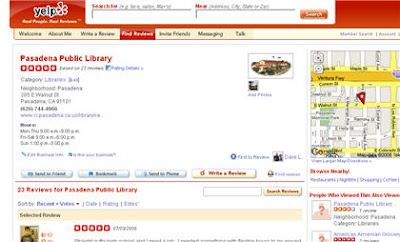
Yelp is a community that allows users to review and rate a restaurant, hotel, theater experience and yes, even a library experience. The Pasadena Public Library (California) has a Yelp page and at least 23 people have chimed in about their experience about using the library.
For the most part, it is a positive experience for patrons. They like the atmosphere, the beauty of the library, that it has wi-fi, and for one user that it still have VHS videos.
Now some folks felt it was creaky as in creaky chairs and tables and didn't care for the restroom. I understand, as did others people that particular issue related to certain members of the homeless population. There is no easy answer about that situation.
Check out the reviews and if you want to chime in on the Pasadena Public Library, most of us who are or have been in the program have been roaming the halls, then you can add your opinion as well.
The other thing to keep in mind about this is that other libraries can be reviewed as well. Especially if you are looking for work in a library and want to know what the patrons feel about their experiences.
The advantages for libraries this is a way to gauge how the public perceives your services and what they found valuable. It gives libraries an way to take a truth pill as to how they are doing.
It is important to remember that these are people that are motivated to share what they think. It may or may not be unbiased but it is one person's opinion gathered in a collection.
For one library in the valley that might be a bitter pill to swallow. I mention no names but people will talk. Some of that conversation is happening on Yelp.
Yelp is a community that allows users to review and rate a restaurant, hotel, theater experience and yes, even a library experience. The Pasadena Public Library (California) has a Yelp page and at least 23 people have chimed in about their experience about using the library.
For the most part, it is a positive experience for patrons. They like the atmosphere, the beauty of the library, that it has wi-fi, and for one user that it still have VHS videos.
Now some folks felt it was creaky as in creaky chairs and tables and didn't care for the restroom. I understand, as did others people that particular issue related to certain members of the homeless population. There is no easy answer about that situation.
Check out the reviews and if you want to chime in on the Pasadena Public Library, most of us who are or have been in the program have been roaming the halls, then you can add your opinion as well.
The other thing to keep in mind about this is that other libraries can be reviewed as well. Especially if you are looking for work in a library and want to know what the patrons feel about their experiences.
The advantages for libraries this is a way to gauge how the public perceives your services and what they found valuable. It gives libraries an way to take a truth pill as to how they are doing.
It is important to remember that these are people that are motivated to share what they think. It may or may not be unbiased but it is one person's opinion gathered in a collection.
For one library in the valley that might be a bitter pill to swallow. I mention no names but people will talk. Some of that conversation is happening on Yelp.
Minggu, 26 Oktober 2008
More Info Book Media Tools - Library 101
If you intend to be a library worker you need to know how to view, download and save an electronic text files, Adobe .pdf files or how to find and listen to an audio recordings.
Hey, I'm In It For the Books. Why Do I Need To Know This Stuff?
Define "book?" This is not a trick question. Traditionally there was a physical, tangible object made of paper and ink called a book. It was and is a delivery device used to convey ideas, stories, methods and instructions. A mighty fine delivery device.
However, it is not the only way to deliver content. A book can now be:
Or, you are asked to find an audio copy of Jane Austen's "Sense and Sensibility" Can you find a legal public domain version in the mp3 format? Could you also find other audio versions performed by professional actors that the patron might want to know about?
To Get You Started:
Try the recommended links and view the web sites. Now if you do this at a public library or even at PCC there may be restrictions on what you can view, download or save to an alternate device.
Some libraries will allow you to save to a USB drive but not to the computer's hard drive. Other will temporarily allow downloading to the computer's hard drive but the user needs to know how to transfer to the USB drive. Ask the staff or read the computer lab policy first.
When searching remember, it is not just about Google. Try Ask.com, Hakia and SearchMe.
Hey, I'm In It For the Books. Why Do I Need To Know This Stuff?
Define "book?" This is not a trick question. Traditionally there was a physical, tangible object made of paper and ink called a book. It was and is a delivery device used to convey ideas, stories, methods and instructions. A mighty fine delivery device.
However, it is not the only way to deliver content. A book can now be:
- An electronic text file that can be read on-line or through a e-book reader and some media players. For example, if you wanted to read a book in the text format you could visit Project Gutenberg to search, download and read books that are in the Public Domain.
- In the Adobe Portable Document Format (.pdf) that can represent book-like feature but allows you to search, annotate and electronically highlight sections. .pdf files are printer friendly and can be sent via e-mail, downloadable via the Internet or compose your own book for distribution. Planet PDF has free books for download such as Anna Karenina, A Tale of Two Cities and Beyond Good and Evil.
- An audio file book can be delivered via vinyl records, cassettes, proprietary audio formats (Audible.com) or in computer audio formats such as .mp3, FLAC, .wav, aiff and other electronic audio fomats. Computer audio formats can be listened to on-line, played back on certain CD/DVD players or from a media players such as Apple's iPod/iTouch, Windows Zune, Creative's Zen and many more. One place to find free audio books is LibriVox. I can personally vouch for The Prisoner of Zenda.
Or, you are asked to find an audio copy of Jane Austen's "Sense and Sensibility" Can you find a legal public domain version in the mp3 format? Could you also find other audio versions performed by professional actors that the patron might want to know about?
To Get You Started:
Try the recommended links and view the web sites. Now if you do this at a public library or even at PCC there may be restrictions on what you can view, download or save to an alternate device.
Some libraries will allow you to save to a USB drive but not to the computer's hard drive. Other will temporarily allow downloading to the computer's hard drive but the user needs to know how to transfer to the USB drive. Ask the staff or read the computer lab policy first.
When searching remember, it is not just about Google. Try Ask.com, Hakia and SearchMe.
Rabu, 22 Oktober 2008
More Info On RSS Readers - Library 101 Presentation
In my presentation I mentioned that RSS stands for Really Simple Syndication. What that means is if you really like the blog and want to be alerted to new content you can copy a bit of code that will connect and keep you up to date with new content.
It is similar to a magazine subscription; you like the magazine and you want to receive it on a regular basis. Unlike magazines there is no fee involved and you can start and stop at any time.
Another way to look at it is there use to be three television networks that created content. After the program was canceled or finished its run it would go into syndication where other television stations could air the show when they wanted to show it to you. Most times it was 4:30a.m.
Instead of a company distributing the content when it wants to the user or patron gets to decide what content to received from millions of choices.
What You Need To Get Started
You will need to have what is called a RSS Reader. This is software that looks at the code, goes to the website or blog and transmits the new content to you. In class, I showed you Bloglines which is a free service that you can use to keep track of your favorite blogs, podcasts and web videos.
If you look at the bottom of the PCC Libtech blog you will see two buttons. One of them is for Bloglines. After you set up your account you can click that button and subscribe to the blog. The orange icon is another way to subscribe to content for other applications and services that use that format.
If you are a Google Guy/Gal no worries. If you use Google applications and services you just need to activate your Google Reader account. Google has a tour page that will explain the process.
Now I've tried to give a basic explanation but there a video that will make it crystal clear. Back in 2007 I wrote about the Common Craft videos and this is an example of my RSS In Plain English post from 2007. Definitely check the video out; it will help you understand and get you started building your link collections.
It is similar to a magazine subscription; you like the magazine and you want to receive it on a regular basis. Unlike magazines there is no fee involved and you can start and stop at any time.
Another way to look at it is there use to be three television networks that created content. After the program was canceled or finished its run it would go into syndication where other television stations could air the show when they wanted to show it to you. Most times it was 4:30a.m.
Instead of a company distributing the content when it wants to the user or patron gets to decide what content to received from millions of choices.
What You Need To Get Started
You will need to have what is called a RSS Reader. This is software that looks at the code, goes to the website or blog and transmits the new content to you. In class, I showed you Bloglines which is a free service that you can use to keep track of your favorite blogs, podcasts and web videos.
If you look at the bottom of the PCC Libtech blog you will see two buttons. One of them is for Bloglines. After you set up your account you can click that button and subscribe to the blog. The orange icon is another way to subscribe to content for other applications and services that use that format.
If you are a Google Guy/Gal no worries. If you use Google applications and services you just need to activate your Google Reader account. Google has a tour page that will explain the process.
Now I've tried to give a basic explanation but there a video that will make it crystal clear. Back in 2007 I wrote about the Common Craft videos and this is an example of my RSS In Plain English post from 2007. Definitely check the video out; it will help you understand and get you started building your link collections.
Senin, 20 Oktober 2008
Celebrating Banned Book Week 09/27-10/4/08
Perhaps this post is a little late but I believe every day we should celebrate the idea of not banning books and embracing a place that encourages nonexistence of censorship.
How did you celebrate Banned Book Week? I will confess that I didn't do much on my part for Banned Book Week since I didn't want to raise too much controversy as a relatively new library aide at the elementary school I work at. Since I just recently opened up the library, I decided to have books on display that dealt with going back to school, being the new kid, and similar issues. Some of these books that I put up just happened to be "banned or challenged books." Since I wasn't doing a banned book display, I decided to put up books dealing with topics of using libraries, history of libraries, and how a book is made. In addition, I found a tween book and YA book whose plots dealt with teens dealing closure of a library or books being banned.
I discovered that Pasadena Central Library celebrated Banned Book Week with a display all month long during multiple visits. At another local library that I go to, I was disappointed that there wasn't any banned book display which surprised me but I didn't inquire as to why there wasn't one there.
Interested in reading more about Banned Book Week, visit ALA. They also talk about the difference between banned and challenged books as well. Check out ALA's Office for Intellectual Freedom on the celebration of banned books through cartoon strips. Another great place to check out is the Banned Books Archive for more information.
I have to say that I really liked this year's slogan of ALA: "Closing books shuts out ideas." Just this past week, a teacher spoke briefly to his class at our elementary school library during the library orientation emphasizing the opportunity to read new books to gain new ideas. Hearing that made me smile. One last slogan I came across in my quest for more information on Banned Books Week was, "Free People Read Freely." Oh, so true!
How did you celebrate Banned Book Week? I will confess that I didn't do much on my part for Banned Book Week since I didn't want to raise too much controversy as a relatively new library aide at the elementary school I work at. Since I just recently opened up the library, I decided to have books on display that dealt with going back to school, being the new kid, and similar issues. Some of these books that I put up just happened to be "banned or challenged books." Since I wasn't doing a banned book display, I decided to put up books dealing with topics of using libraries, history of libraries, and how a book is made. In addition, I found a tween book and YA book whose plots dealt with teens dealing closure of a library or books being banned.
I discovered that Pasadena Central Library celebrated Banned Book Week with a display all month long during multiple visits. At another local library that I go to, I was disappointed that there wasn't any banned book display which surprised me but I didn't inquire as to why there wasn't one there.
Interested in reading more about Banned Book Week, visit ALA. They also talk about the difference between banned and challenged books as well. Check out ALA's Office for Intellectual Freedom on the celebration of banned books through cartoon strips. Another great place to check out is the Banned Books Archive for more information.
I have to say that I really liked this year's slogan of ALA: "Closing books shuts out ideas." Just this past week, a teacher spoke briefly to his class at our elementary school library during the library orientation emphasizing the opportunity to read new books to gain new ideas. Hearing that made me smile. One last slogan I came across in my quest for more information on Banned Books Week was, "Free People Read Freely." Oh, so true!
Minggu, 19 Oktober 2008
Prologue Magazine - National Archives and Records Adminstration
There is an abundance of historical information contained in the National Archives and Records Administration's (NARA) web site. One area I'd like to draw your attention to is the quarterly magazine Prologue.

Prologue is a great resource. Did you know that there was a court case about frozen ice cream and flavored ice between Popsicle and Good Humor? Or that there were inconsistent rules applied to women and naturalization between 1802 to 1940?
Many people have issues about the response handling in the aftermath of Hurricane Katrina but did you know that there were slackers, looters and governmental incompetents that added to the confusion on who was responsible during San Francisco 1906 Earthquake?
You can read and decide for yourself if history repeats itself in the article "When an American City Is Destroyed, The U.S. Military as First Responders to the San Francisco Earthquake a Century Ago".
There is a lot of talk recently about subversives, anti-Americans and being "the other." It is scary stuff but it is not new to the country. In Prologue magazine there is an article about how the McCarthy era came into being by the Attorney General's List of Subversive Organizations (AGLOSO).
You can learn about how fear took root the government and in the country. Once you know how it got started you can be on the look out for new versions that are being implied or suggested.
This is your tax dollars being put to wonderful use. I would certainly add this to your information tool kit.
Prologue is a great resource. Did you know that there was a court case about frozen ice cream and flavored ice between Popsicle and Good Humor? Or that there were inconsistent rules applied to women and naturalization between 1802 to 1940?
Many people have issues about the response handling in the aftermath of Hurricane Katrina but did you know that there were slackers, looters and governmental incompetents that added to the confusion on who was responsible during San Francisco 1906 Earthquake?
You can read and decide for yourself if history repeats itself in the article "When an American City Is Destroyed, The U.S. Military as First Responders to the San Francisco Earthquake a Century Ago".
There is a lot of talk recently about subversives, anti-Americans and being "the other." It is scary stuff but it is not new to the country. In Prologue magazine there is an article about how the McCarthy era came into being by the Attorney General's List of Subversive Organizations (AGLOSO).
You can learn about how fear took root the government and in the country. Once you know how it got started you can be on the look out for new versions that are being implied or suggested.
This is your tax dollars being put to wonderful use. I would certainly add this to your information tool kit.
Minggu, 10 Agustus 2008
National Archives Videos on Google
The National Archives and Records Administration, in partnership with Google, has uploaded a number of videos to Google Video. This is a good resource for researchers, writers and students.
 There are currently 110 videos from the following categories:
These are recordings of their time produced by the United States Government. For the most part these are promotional or public relations generated movies that might have appeared at the local movie theater before the main show. They are a reflection of the what was known and presented as fact.
For patrons looking to historical research, students who are writing papers or historians trying to document changes in attitudes about topics this is a resource that should not be ignored.
There are currently 110 videos from the following categories:- NASA History of Space Flight Motion Pictures which has a 1981 video on Space for Women, The difficulty in 1967 of Photographing the Moon and a 1963 biography of John Glenn with an introduction by President Kennedy
- United Newsreel Motion Pictures (1942-1945) covering World War II that has video of Women serving as mechanics in the Army, Celebrities promoting a war bond drive in 1942 and the swearing in of President Truman with a retrospective of Franklin D. Roosevelt
- Department of the Interior Motion Pictures - there are videos showing the construction of Boulder Dam, Native Americans, and the distribution of water in the Western states.
These are recordings of their time produced by the United States Government. For the most part these are promotional or public relations generated movies that might have appeared at the local movie theater before the main show. They are a reflection of the what was known and presented as fact.
For patrons looking to historical research, students who are writing papers or historians trying to document changes in attitudes about topics this is a resource that should not be ignored.
Sabtu, 26 Juli 2008
When A Book Is Challenged - An Example of A Response
I want to refer folks over to Mylibog for an example of how a librarian responded to a parent's concern about a children's book "My Uncle Bobby's Wedding."
In Library 101 there were discussions about the rights of parents to challenge materials and library workers knowing the existing guidelines of the library in regard to challenges to books and materials.
This also touches on collection development issues raised in Library 104. One of the issues the letter brings up is can you deny services to one group while honoring others who feel offended by the material?
What are the stated policies for a patron to respond to a book that they really object to being in the library? This post is an essential read.
In Library 101 there were discussions about the rights of parents to challenge materials and library workers knowing the existing guidelines of the library in regard to challenges to books and materials.
This also touches on collection development issues raised in Library 104. One of the issues the letter brings up is can you deny services to one group while honoring others who feel offended by the material?
What are the stated policies for a patron to respond to a book that they really object to being in the library? This post is an essential read.
Kamis, 17 Juli 2008
Library Technology Program Update
With the retirement of Joanne Kim, PCC Librarian Krista Goguen will assume the Program Coordinator duties for the Library Technology Certificate Program. Krista has served on the Program Advisory Committee, taught LIB 1 and LIB 10A and helped develop curriculum for the program courses. She will teach LIB 101 in Fall 2008. Krista will maintain the Library Technology Program webpages and the e-mail list. The Library Technology Blog will continue to be maintained by Gena Haskett and Evelyn Keolian.
Please feel free to contact Krista Goguen or Mary Ann Laun at the following:
Krista Goguen
Office: LL303
Phone: 626-585-7832
E-mail: kfgoguen@pasadena.edu
Mary Ann Laun, Library Dean
Phone: 626-585-7833
E-mail: malaun@pasadena.edu
Please feel free to contact Krista Goguen or Mary Ann Laun at the following:
Krista Goguen
Office: LL303
Phone: 626-585-7832
E-mail: kfgoguen@pasadena.edu
Mary Ann Laun, Library Dean
Phone: 626-585-7833
E-mail: malaun@pasadena.edu
Minggu, 15 Juni 2008
KOCE Copyright For Educators Videos
It seems that issues of copyright and fair use keep forcing me to pay attention to how copyright affects libraries, users, bloggers and businesses. So I keep an eye out for any resource that can help explain the rules of the game

I found this KOCE TV series on TeacherTube and you can view them in the Flash video format.
There is a supporting web site Orange County Public Television's page at www.copyrighteducation.org The video on the web site are in the Windows WMV format
The focus of the program is teaching copyright issues to teachers, administrators and board members and other folk that are involved with education. There is solid information in the videos. Content-wise, I have no complaints.
But...well, it is a living example of "Death by PowerPoint." It is extremely static. The host is moving and shifting from side to side but my goodness it is visually dry. The topics are in a bullet lists and there are very few photo or visual examples of what the guy is talking about.
Now the host did say in the introduction video that the program was geared to those in education. But teachers are human too. With all the talent and creativity in the Los Angeles and Orange county areas all teachers get is Voice + PowerPoint?
I tried listening to it and not watching the video. Didn't miss a thing. So stylistically I give it a raspberry. I have to give it another raspberry because I couldn't see where it was captioned or closed captioned. and there is no transcript available on the website.
I'm learning that captions and transcripts are not just for hearing impaired folks. In certain work situations you can see video but don't have speakers. Or you can't view the video in a certain format.
I also recognize that I'm a hypocrite about this topic so I take back my raspberry. Anyway, it is a good information resource and you should check it out.
I found this KOCE TV series on TeacherTube and you can view them in the Flash video format.
There is a supporting web site Orange County Public Television's page at www.copyrighteducation.org The video on the web site are in the Windows WMV format
The focus of the program is teaching copyright issues to teachers, administrators and board members and other folk that are involved with education. There is solid information in the videos. Content-wise, I have no complaints.
But...well, it is a living example of "Death by PowerPoint." It is extremely static. The host is moving and shifting from side to side but my goodness it is visually dry. The topics are in a bullet lists and there are very few photo or visual examples of what the guy is talking about.
Now the host did say in the introduction video that the program was geared to those in education. But teachers are human too. With all the talent and creativity in the Los Angeles and Orange county areas all teachers get is Voice + PowerPoint?
I tried listening to it and not watching the video. Didn't miss a thing. So stylistically I give it a raspberry. I have to give it another raspberry because I couldn't see where it was captioned or closed captioned. and there is no transcript available on the website.
I'm learning that captions and transcripts are not just for hearing impaired folks. In certain work situations you can see video but don't have speakers. Or you can't view the video in a certain format.
I also recognize that I'm a hypocrite about this topic so I take back my raspberry. Anyway, it is a good information resource and you should check it out.
Minggu, 27 Januari 2008
Business Librarians - An Overview & Resources
Just as a medical librarian is experienced in locating information on health related topics a business librarian is able to located data on topics such as quarterly earnings in the pet food industry, which database is best for corporate intelligence and just what are "Derivatives"?
Business librarians can be found in academic, public and corporate libraries or as independent contractors.
They will know how to locate information on entrepreneurship, financial literacy; they can dig deep into finding the historical performance of a stock or help you navigate the huge amount of statistical information that the United States produces in a given year.
Even if you have no plans of becoming a librarian the following resources might help you to direct patrons to the people and resources that can be of assistance.
American Library Association Business Reference and Services Section (BRASS) is a section of the References and Users Services Association. The articles and newsletters that I found online talk about issues that specifically relate to this aspect of librarianship. One of the articles that was helpful was the Best of the Business Web Sites which covers web resources such as Accounting and Taxation, Electronic Commerce, Hospitality and International Business.
BRINT - Don't let the amount of information presented on the first page scare you away, it is overwhelming. Think of BRINT as a portal. You locate the term you are researching, say CRM (Customer Relations Management). This will lead you to links on books, articles, research, blogs and other resources.
BRINT helps to narrow down business related search topics. It basically constructs the search term for you and then leads you to the results. Caution: some of the search engines listed at the bottom of the pages have been discontinued, i.e. Teoma was acquired by Ask.com.
Business Librarians Social Networking at Ning. Laurie Bridges created this social network for academic, public and other folks who work with this specialized knowledge set.
Business librarians can be found in academic, public and corporate libraries or as independent contractors.
They will know how to locate information on entrepreneurship, financial literacy; they can dig deep into finding the historical performance of a stock or help you navigate the huge amount of statistical information that the United States produces in a given year.
Even if you have no plans of becoming a librarian the following resources might help you to direct patrons to the people and resources that can be of assistance.
American Library Association Business Reference and Services Section (BRASS) is a section of the References and Users Services Association. The articles and newsletters that I found online talk about issues that specifically relate to this aspect of librarianship. One of the articles that was helpful was the Best of the Business Web Sites which covers web resources such as Accounting and Taxation, Electronic Commerce, Hospitality and International Business.
BRINT - Don't let the amount of information presented on the first page scare you away, it is overwhelming. Think of BRINT as a portal. You locate the term you are researching, say CRM (Customer Relations Management). This will lead you to links on books, articles, research, blogs and other resources.
BRINT helps to narrow down business related search topics. It basically constructs the search term for you and then leads you to the results. Caution: some of the search engines listed at the bottom of the pages have been discontinued, i.e. Teoma was acquired by Ask.com.
Business Librarians Social Networking at Ning. Laurie Bridges created this social network for academic, public and other folks who work with this specialized knowledge set.
Langganan:
Postingan (Atom)