The iPad gets all of the attention but there really area other tablets in production and there are Apps (application) that are being designed to make shelf reading easier.
This is a prototype of an application designed for the Android system that was presented at the ACRL 2011 Conference in Philadelphia, PA. This application used with a computer tablet or smartphone would make circulation a lot easier.
This is just a prototype. There are issues about spine width, the types of classification system use or perhaps even thinking about using QR codes that could embed the DDC/LC systems instead.
If this is transferred into libraries it might mean there is one less library support person necessary. On the other hand the gizmo can't walk itself and there will be some materials that will not lend themselves to use by the App.
Tampilkan postingan dengan label Library 102. Tampilkan semua postingan
Tampilkan postingan dengan label Library 102. Tampilkan semua postingan
Minggu, 15 Mei 2011

Minggu, 04 Oktober 2009
Search Engine Tips - InTitle Search Video
I am finding that what I thought I would be doing with my library skills and what has come to pass are way different. I thought by this time I would be doing this in a library situation. I am reminded that the library has expanded a thousand fold.
I am certainly applying reference and ready reference skills in my writing. I have been working on a few new projects. One of those projects is to learn how to better present information using video.
This is a short videos showing how to use the InTitle search operator to find websites that have a specific word in the title.
This is both exciting and terrifying to start down a blind alley. One of the things I am constantly telling people is the need for flexibility and the ability to scope out new opportunities.
I've seen a lot of bad tutorials. I also see a need for tutorials in areas that are not being serviced. As the world moves from a paper based communication system to an electronic one there still needs to be sources of credible information. Those of us at the nexus point have to be involved in this process.
Anyway, there will be a few more videos and my continuing resolve to find a captioning program that works and doesn't make me feel stupid in the process. If you have time I would love feedback or topic suggestions.
I am certainly applying reference and ready reference skills in my writing. I have been working on a few new projects. One of those projects is to learn how to better present information using video.
This is a short videos showing how to use the InTitle search operator to find websites that have a specific word in the title.
Audio Transcript
Are you searching for a web page that has a specific title?
Save yourself some grief, here's how.
Click in the Search box and type intitle:(don't use the spacebar)and now type the search term, in this case libguides.
As you can see, there is a list of other suggested searches that may or may not have anything to do with what you are looking for; if these are bothersome you can turn them off.
When you are ready, click the Search button or hit the Enter key on your keyboard.
Ask.com will show you a list of all of the web pages that use the term "libguides" in the title. This is a pretty effective way of targeting those websites that specifically talk about, in this case library guides.
You can perform the same operator search in Bing, for example
intitle:libguides
This is the listings of websites that have "libguides" in the title.
And yes, you can use the intitle: search on Google as well.
The Journey So Far
This is both exciting and terrifying to start down a blind alley. One of the things I am constantly telling people is the need for flexibility and the ability to scope out new opportunities.
I've seen a lot of bad tutorials. I also see a need for tutorials in areas that are not being serviced. As the world moves from a paper based communication system to an electronic one there still needs to be sources of credible information. Those of us at the nexus point have to be involved in this process.
Anyway, there will be a few more videos and my continuing resolve to find a captioning program that works and doesn't make me feel stupid in the process. If you have time I would love feedback or topic suggestions.
Selasa, 29 September 2009
ProQuest Example Video from Mike Johnson
Mike Johnson is an Assistant Librarian at Bloomquest College in New Jersey. He created an easy to understand demonstration video on using ProQuest to find a specific topic in a specific journal article.
Mike is using a free online program called ScreenToaster. One of the features of that service is that it makes it easier to add subtitles and captions to videos.
Anyway, this is a really clear, quick instruction on how to get the most of ProQuest.
Mike is using a free online program called ScreenToaster. One of the features of that service is that it makes it easier to add subtitles and captions to videos.
Anyway, this is a really clear, quick instruction on how to get the most of ProQuest.
Rabu, 29 Juli 2009
Bob Ducket on Using Your Wits
I subscribe to a lot of blogs and websites, both within and outside of the library community. Some times it happens that a non-library resource leads me back to a topic that was covered in the program.
This is one of those times. Bob Duckett was a Reference Librarian of Bradford City Libraries in the United Kingdom. In the post entitled "Reference Desk: Tips on Using Your Wits" he writes about how do you effectively find information for library patrons, no matter when you started learning how to do so.
UK vs US Terminology
This is a guess on my part but when Bob talks about the Enquiry Desk I think that is the same as our Reference Desk. This is a sample:
Take Away Points
Much of what he has to same is common sense but since that is not so common you should be on the safe side and read this anyway. The three main take away point I got were:
This is one of those times. Bob Duckett was a Reference Librarian of Bradford City Libraries in the United Kingdom. In the post entitled "Reference Desk: Tips on Using Your Wits" he writes about how do you effectively find information for library patrons, no matter when you started learning how to do so.
UK vs US Terminology
This is a guess on my part but when Bob talks about the Enquiry Desk I think that is the same as our Reference Desk. This is a sample:
I exaggerate, and lucky you if you know your clientele and know what their likely demands will be: the course that students will be doing perhaps, or the job descriptions of users of a firm's library. But on a public library counter the next enquirer is likely to be unknown to you. You are at the mercy of the World and his Significant Other.Yes, my years of watching Dr. Who has come in handy. Which is another point in the article, you want a broad based of knowledge. It is not just the academics, it is the connection with the various worlds we occupy. Your hobbies, past careers and eccentricities are a bonus to be embraced. You will be surprised on how helpful they can be in a pinch.
Take Away Points
Much of what he has to same is common sense but since that is not so common you should be on the safe side and read this anyway. The three main take away point I got were:
- Never talk down to a patron
- Use the interview format to properly understand your patrons needs
- Know your sources and resources. Not everything can be found on the Internet so be open to cracking a book open once in a while. If the microfilm/fiche reader is functional give it a go and discover the past.
Jumat, 15 Mei 2009
Science.Gov Portal To U.S. Science Information
I found out about this via the ALA Federal Library and Armed Forces Library Roundtable ListServ. Science.gov is a portal to various governmental databases and technical information sites. It might make it a little easier to locate governmental authoritative sources.
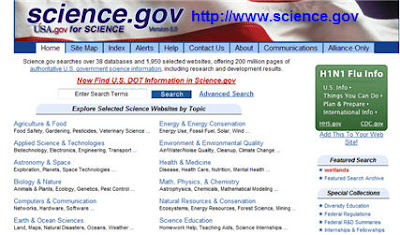 I looked under the category of Science Education. There are links to sources from the Library of Congress, National Science Foundations, NASA and so many more agencies that have science data.
You can enter a search term or you can use the advanced search to find by keyword, title or to select just the area you want to discover.
Science.gov is a great help in finding data but I do want to mention a concern. I followed a group of links about chemistry clip art from the Food and Drug Administration. Many of the links were dead or long gone.
Not blaming the FDA for this, external websites change all the time. Part of the responsibility is trying to maintain quality links so you do have to go back and see if a source listed in 1999 is still viable in 2009.
Science.gov is a cool resource that can help you locate governmental science related materials. I'll spend a little more time checking it out.
I looked under the category of Science Education. There are links to sources from the Library of Congress, National Science Foundations, NASA and so many more agencies that have science data.You can enter a search term or you can use the advanced search to find by keyword, title or to select just the area you want to discover.
Science.gov is a great help in finding data but I do want to mention a concern. I followed a group of links about chemistry clip art from the Food and Drug Administration. Many of the links were dead or long gone.
Not blaming the FDA for this, external websites change all the time. Part of the responsibility is trying to maintain quality links so you do have to go back and see if a source listed in 1999 is still viable in 2009.
Science.gov is a cool resource that can help you locate governmental science related materials. I'll spend a little more time checking it out.
Senin, 23 Februari 2009
Beware Of Papercuts - A Library Assistant Blog
This happens to me every now and then. I was having a conversation with a group of people. It was totally friendly. I was explaining my concerns about the switch to digital television. One person asked me could I dumb it down for normal people.
There was laughter. I must have had my deer in the headlights look. I simplified what I had mentioned that even if you have a digital converter it may not work for a number of reasons.
Honestly, inside I felt stupid. I forgot to switch from nerd/nerdette speak to folks that don't know what a blog is or why it is important to know. It is important to be language aware of what you are saying and how you are saying it. I get so eager to share that I forget to switch modes.
Will I do it again? Heck yeah but hopefully I will pause and make sure what I am saying is going to be heard and not blocked because of the way that I am saying it.

A few months back there was a comment about how some of the items that I post tend to be about technology and don't really have anything to do with the program. I have to plead guilty to my biases. However my lust for information technology really does have a lot to do with the evolving workplace known as the library.
After you leave the program you will encounter these technologies and expected to use them or learn them very quickly. There will be things that have not been invented yet but those items will impact your life and your library visitors.
So I'm doing a little happy dance when I found the Beware Of Papercuts blog. Podcasting for Libraries - yes you should know how to find podcast beyond iTunes, how to create them and why that could be a useful skill. Twitter? For sure. Tools for your cell phone? Check.
So if you have a chance check out the Laughing Library Clerk as she gives you real working examples of how to incorporate technology with providing services.
There was laughter. I must have had my deer in the headlights look. I simplified what I had mentioned that even if you have a digital converter it may not work for a number of reasons.
Honestly, inside I felt stupid. I forgot to switch from nerd/nerdette speak to folks that don't know what a blog is or why it is important to know. It is important to be language aware of what you are saying and how you are saying it. I get so eager to share that I forget to switch modes.
Will I do it again? Heck yeah but hopefully I will pause and make sure what I am saying is going to be heard and not blocked because of the way that I am saying it.
A few months back there was a comment about how some of the items that I post tend to be about technology and don't really have anything to do with the program. I have to plead guilty to my biases. However my lust for information technology really does have a lot to do with the evolving workplace known as the library.
After you leave the program you will encounter these technologies and expected to use them or learn them very quickly. There will be things that have not been invented yet but those items will impact your life and your library visitors.
So I'm doing a little happy dance when I found the Beware Of Papercuts blog. Podcasting for Libraries - yes you should know how to find podcast beyond iTunes, how to create them and why that could be a useful skill. Twitter? For sure. Tools for your cell phone? Check.
So if you have a chance check out the Laughing Library Clerk as she gives you real working examples of how to incorporate technology with providing services.
Minggu, 08 Februari 2009
ZIP Codes and A Bit of History Too
Did you know that the letters ZIP refer to the Zone Improvement Plan? Or that the character on postal advertisements is known as Mr. Zip? You can learn a lot of things by visiting the post office web site. For those of you who are building your Ready Reference toolkit here is one more goody that you can use.
Most folks know that there are ZIP code books published by the United States Post Office. Two large and heavy books. The only problem with the books is that ZIP codes can be changed or modified. Or a city is renamed. Or the city name "disappears."
There is an better way if you have access to the Internet. The ZIP Code finder is very helpful.
 You can find the ZIP code for a specific address or a city:

If you know the ZIP code you can find the city name:
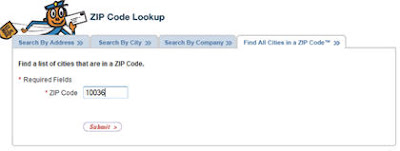
This is where the history part comes in. Many cities have multiple names for the same geographic area. Some are historical or regional. City names change over time, so that the name the patron uses might not be the actual city name.
For example:

The legal city name is New York. People who live in that area or who have written about that specific area may call it Manhattan. The Post Office would like you to address mail as New York, NY but you might have a patron approach you to find the zip code for Manhattan. By using the City or ZIP Code search you can obtain the correct information.
Now it doesn't always mean you can't use the historical or regional. In the Los Angeles area we are aware of the city of Eagle Rock. The Post Office considers it an acceptable city name:
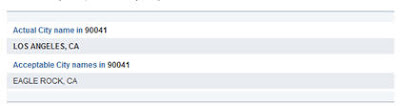 In this case it is ok to use either the legal name, Los Angeles or the historical/regional name, Eagle Rock for this section of town.
Other Uses for USPS.com ZIP Code Finder
This could be helpful for genealogical searches. A patron may have a document that states a person was born in a certain area of town. They can't find it on a modern map. You can use the ZIP Code search to help you find out the historical name and the contemporary name of a location. You also might want to cross check with a gazetteer as well.
There are certain schools, hospitals and businesses that are so large they have their own specialized zip code. 00401 belongs to the Reader's Digest Association in Pleasantville, New York.
So if you want to build up you pecks continue using the books. If you need to know right now then you should visit www.usps.com
Most folks know that there are ZIP code books published by the United States Post Office. Two large and heavy books. The only problem with the books is that ZIP codes can be changed or modified. Or a city is renamed. Or the city name "disappears."
There is an better way if you have access to the Internet. The ZIP Code finder is very helpful.
You can find the ZIP code for a specific address or a city:If you know the ZIP code you can find the city name:
This is where the history part comes in. Many cities have multiple names for the same geographic area. Some are historical or regional. City names change over time, so that the name the patron uses might not be the actual city name.
For example:
The legal city name is New York. People who live in that area or who have written about that specific area may call it Manhattan. The Post Office would like you to address mail as New York, NY but you might have a patron approach you to find the zip code for Manhattan. By using the City or ZIP Code search you can obtain the correct information.
Now it doesn't always mean you can't use the historical or regional. In the Los Angeles area we are aware of the city of Eagle Rock. The Post Office considers it an acceptable city name:
In this case it is ok to use either the legal name, Los Angeles or the historical/regional name, Eagle Rock for this section of town.Other Uses for USPS.com ZIP Code Finder
This could be helpful for genealogical searches. A patron may have a document that states a person was born in a certain area of town. They can't find it on a modern map. You can use the ZIP Code search to help you find out the historical name and the contemporary name of a location. You also might want to cross check with a gazetteer as well.
There are certain schools, hospitals and businesses that are so large they have their own specialized zip code. 00401 belongs to the Reader's Digest Association in Pleasantville, New York.
So if you want to build up you pecks continue using the books. If you need to know right now then you should visit www.usps.com
Sabtu, 03 Januari 2009
Children's Book, Reference and Nonfiction Blog
I used to know kid books because I was a kid. I'm a little older now so I need help to find materials for the young ones. There are a lot more questions around than when I was a kid and I had a bunch even then.
I happened to find this blog, Children Books, Reference and Nonfiction blog about books, reference materials and non-fiction for young people.
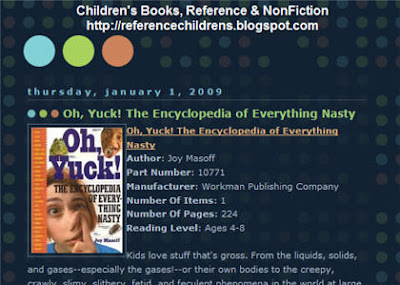
This is a relatively new blog but Donna has been busy stock it with books that curious minds need to answer their questions. I'll keep an eye out for it and see what new items there are in kid references.
I happened to find this blog, Children Books, Reference and Nonfiction blog about books, reference materials and non-fiction for young people.
This is a relatively new blog but Donna has been busy stock it with books that curious minds need to answer their questions. I'll keep an eye out for it and see what new items there are in kid references.
Jumat, 26 Desember 2008
Biographical Directory of the United States Congress
The United States Congress has an easy way for you to obtain historical and biographical information on the men and women who serve in Congress.
The Biographical Directory of the United States Congress can help students and historical researchers get information quickly and without a lot of trouble.

The Biographic Directory can be searched by the name of the congress member, the party, state or year of service.
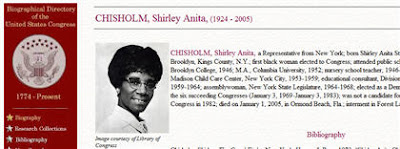
You will see a photo or illustration of the congressperson and a historical record of their education, prior employment held before becoming a member of Congress, party affiliations and notable achievements.
The database contains records from 1774 to the present time so you should be able to find anyone who has served in the House or the Senate.
The Biographical Directory of the United States Congress can help students and historical researchers get information quickly and without a lot of trouble.
The Biographic Directory can be searched by the name of the congress member, the party, state or year of service.
You will see a photo or illustration of the congressperson and a historical record of their education, prior employment held before becoming a member of Congress, party affiliations and notable achievements.
The database contains records from 1774 to the present time so you should be able to find anyone who has served in the House or the Senate.
Minggu, 21 Desember 2008
Legal Glossaries And Dictionaries
With all the financial, legal and political mischief that is occurring in the news I thought that this might be a good time to provide resources to legal terms and expressions.
These are on-line glossaries and dictionaries that can help make sense of some of the legal concepts that will be introduced in the coming year. For those of you of a tactile nature and have access to PCC's Shatford Library the following items are on the shelves:
Many libraries will have at least one or all of these dictionaries in their reference stacks but the Dewey number or Library of Congress number may be different. When in doubt ask at the Reference desk.
Glossaries of Legal Words, Terms and Expressions
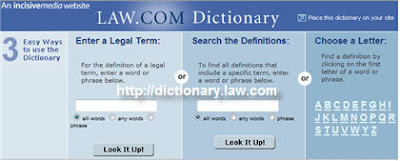
These are on-line glossaries and dictionaries that can help make sense of some of the legal concepts that will be introduced in the coming year. For those of you of a tactile nature and have access to PCC's Shatford Library the following items are on the shelves:
- Black's Law Dictionary REF 340.03 B 1-3 1999 This is also available on-line if you have access to Westlaw.
- A Dictionary of Modern Legal Usage REF 340.03 G 1 1995
- Real Life Dictionary of the Law REF 340.03 H 2
Many libraries will have at least one or all of these dictionaries in their reference stacks but the Dewey number or Library of Congress number may be different. When in doubt ask at the Reference desk.
Glossaries of Legal Words, Terms and Expressions
- Lawyer's.com Glossary - You can select the most frequently used terms or enter your word or phrase in the search box. Very handy when you need to know what Fraud in the factum means.
- Nolo's Law Glossary - What does lex loci mean? What is the exact meaning of the McNaghten Rule? A good resource for accessible meanings to legal terms.
- Dictionary at Law.com - You can search a term, a definition or choose your favorite legal letter of the alphabet to find your legal meaning or concept.
- Merriam-Webster's Dictionary of Law at Google Book Search - This is a limited preview version of the dictionary but the section that is available maybe all that you need to locate the legal term of your choice.
- Duhaime.org - If you need to research Canadian legal terminology this dictionary is maintained by Barrister and Solicitor Lloyd Duhaime. Not only can you search by letter or by the newest additions you can also check out Canadian legal history and Canadian laws.
Minggu, 19 Oktober 2008
Prologue Magazine - National Archives and Records Adminstration
There is an abundance of historical information contained in the National Archives and Records Administration's (NARA) web site. One area I'd like to draw your attention to is the quarterly magazine Prologue.

Prologue is a great resource. Did you know that there was a court case about frozen ice cream and flavored ice between Popsicle and Good Humor? Or that there were inconsistent rules applied to women and naturalization between 1802 to 1940?
Many people have issues about the response handling in the aftermath of Hurricane Katrina but did you know that there were slackers, looters and governmental incompetents that added to the confusion on who was responsible during San Francisco 1906 Earthquake?
You can read and decide for yourself if history repeats itself in the article "When an American City Is Destroyed, The U.S. Military as First Responders to the San Francisco Earthquake a Century Ago".
There is a lot of talk recently about subversives, anti-Americans and being "the other." It is scary stuff but it is not new to the country. In Prologue magazine there is an article about how the McCarthy era came into being by the Attorney General's List of Subversive Organizations (AGLOSO).
You can learn about how fear took root the government and in the country. Once you know how it got started you can be on the look out for new versions that are being implied or suggested.
This is your tax dollars being put to wonderful use. I would certainly add this to your information tool kit.
Prologue is a great resource. Did you know that there was a court case about frozen ice cream and flavored ice between Popsicle and Good Humor? Or that there were inconsistent rules applied to women and naturalization between 1802 to 1940?
Many people have issues about the response handling in the aftermath of Hurricane Katrina but did you know that there were slackers, looters and governmental incompetents that added to the confusion on who was responsible during San Francisco 1906 Earthquake?
You can read and decide for yourself if history repeats itself in the article "When an American City Is Destroyed, The U.S. Military as First Responders to the San Francisco Earthquake a Century Ago".
There is a lot of talk recently about subversives, anti-Americans and being "the other." It is scary stuff but it is not new to the country. In Prologue magazine there is an article about how the McCarthy era came into being by the Attorney General's List of Subversive Organizations (AGLOSO).
You can learn about how fear took root the government and in the country. Once you know how it got started you can be on the look out for new versions that are being implied or suggested.
This is your tax dollars being put to wonderful use. I would certainly add this to your information tool kit.
Minggu, 05 Oktober 2008
Adam Matthews Digital Subscription Resources
Adam Matthew Digital is a subscription database that handles specialized collections. The target audience would be those folks interested in research, education and librarianship.

The collections are divided into 20 areas of focus that include:
The collection draws upon the experience of teachers, professors and library collections. There are essays available to provide an introduction. This is a fee based service but there are free samples that you can use to evaluate the usefulness of the collections.
I was able to find an sample article on "Research Strategies on Women, Popular Culture and Family Life in American 1800-1920" by Amy Blair, Assistant Professor, Marquette University.
It was a review of the publication of that time that reflected the cultural values of what a woman should aspire in terms of her home, domestic affairs and fashion.
If you are interested in evaluation the site there is a four week trial period that is available to librarians or school faculty. There is none available to students. However I would suggest that students keep an eye out for some of the free sample information that is located on the site. A few of the freebies that I found was very informative.
The collections are divided into 20 areas of focus that include:
- America, Asia and the Pacific
- India, Raj and Empire
- Defining Gender, 1450 - 1910
- Travel Writing, Spectacle and World History
- China, Trade, Politics and Culture 1893-1980
The collection draws upon the experience of teachers, professors and library collections. There are essays available to provide an introduction. This is a fee based service but there are free samples that you can use to evaluate the usefulness of the collections.
I was able to find an sample article on "Research Strategies on Women, Popular Culture and Family Life in American 1800-1920" by Amy Blair, Assistant Professor, Marquette University.
It was a review of the publication of that time that reflected the cultural values of what a woman should aspire in terms of her home, domestic affairs and fashion.
If you are interested in evaluation the site there is a four week trial period that is available to librarians or school faculty. There is none available to students. However I would suggest that students keep an eye out for some of the free sample information that is located on the site. A few of the freebies that I found was very informative.
Minggu, 07 September 2008
The Carlyle Letters - Victorian Reference Sources
There is something to be said about obtaining history from primary sources. If you are interested in the Victorian era, life during the time of the potato famine or how people communicated without cell phones, Internet or even telegraph then you should visit The Carlyle Letters Online from Duke University Press.
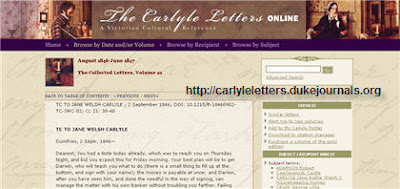
You will have the opportunity to meet Thomas and Jane Carlyle and be introduced to some of their family, friends and life in the 19th century. There are over 10,000 letters written to and from the leading lights of the day such as Elizabeth Barrett Browning and Robert Browning, Charles Dickens, George Eliot, Ralph Waldo Emerson and many more.
You will also get a sense of gender relations, travel, the importance of the Victorian class system and an overview of the society at that time.
Insight on the Potato Famine
One of the letters I read talked about the Irish population and the Potato Famine. The disease that infected potato cultivation did not just affect the Irish community. Most of the United Kingdom was impacted. As the potato crop died other crops became more valuable and fortunes were lost and made because of the famine.
I learned that there was a proposal to provide job infrastructure projects to help the Irish population sustain itself. The project was discourage and defeated by the merchants and landlords. The business class felt that such assistance would be a violation of free trade. It gives me an opportunity to compare that sentiment with discussions we in the 21st century are having about health care and governmental involvement.
Easy To Navigate and Find Information
It is easy to find letters on a certain topic. You can search by date, by the recipient of the letter or by subject. For example, when I selected London Library, I was provided a list of letters that talked of Thomas Carlyle's concern about who should be the next Librarian.
The letters are all connected via links so that you can follow the flow of the "conversations" or jump to a specific writer and follow his/her contributions. There are subject notes and footnotes to help explain changes in meaning or obscure words.
This is an excellent resource to add to your research and information gathering kit.
You will have the opportunity to meet Thomas and Jane Carlyle and be introduced to some of their family, friends and life in the 19th century. There are over 10,000 letters written to and from the leading lights of the day such as Elizabeth Barrett Browning and Robert Browning, Charles Dickens, George Eliot, Ralph Waldo Emerson and many more.
You will also get a sense of gender relations, travel, the importance of the Victorian class system and an overview of the society at that time.
Insight on the Potato Famine
One of the letters I read talked about the Irish population and the Potato Famine. The disease that infected potato cultivation did not just affect the Irish community. Most of the United Kingdom was impacted. As the potato crop died other crops became more valuable and fortunes were lost and made because of the famine.
I learned that there was a proposal to provide job infrastructure projects to help the Irish population sustain itself. The project was discourage and defeated by the merchants and landlords. The business class felt that such assistance would be a violation of free trade. It gives me an opportunity to compare that sentiment with discussions we in the 21st century are having about health care and governmental involvement.
Easy To Navigate and Find Information
It is easy to find letters on a certain topic. You can search by date, by the recipient of the letter or by subject. For example, when I selected London Library, I was provided a list of letters that talked of Thomas Carlyle's concern about who should be the next Librarian.
The letters are all connected via links so that you can follow the flow of the "conversations" or jump to a specific writer and follow his/her contributions. There are subject notes and footnotes to help explain changes in meaning or obscure words.
This is an excellent resource to add to your research and information gathering kit.
Minggu, 10 Agustus 2008
Calisphere and California Cultures
Calisphere is a project of the California Digital Library. It's mission is to provide public online access to some of the collections from the University of California Libraries, Museums and contributing public library systems.
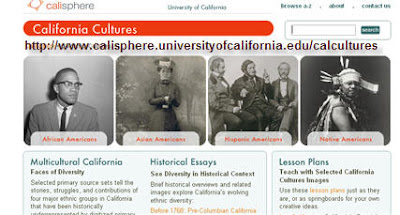
The California Cultures website is especially interesting. This gives a visitor the ability to find out information about African American, Asian, Hispanic and Native American cultures.
I decided to explore the Asian American section. There are a number of pathways I could follow such as the Gold Rush Era with an historical overview of the time.

I also was able to view photographs, advertisements and some of the anti-immigration publications of the time. Depending on the amount of documentation available you can find out the source of the photo, the context and related keyword searches to help you access even more information.
Where available there are letters, political cartoons, oral histories and diaries and other materials to aid in researching a topic such as the Transcontinental Railroad.
You could spend hours reading and catching up with the good and the bad of California's history. And you will learn a lot about how different ethnic groups shaped that history.

The California Cultures website is especially interesting. This gives a visitor the ability to find out information about African American, Asian, Hispanic and Native American cultures.
I decided to explore the Asian American section. There are a number of pathways I could follow such as the Gold Rush Era with an historical overview of the time.
I also was able to view photographs, advertisements and some of the anti-immigration publications of the time. Depending on the amount of documentation available you can find out the source of the photo, the context and related keyword searches to help you access even more information.
Where available there are letters, political cartoons, oral histories and diaries and other materials to aid in researching a topic such as the Transcontinental Railroad.
You could spend hours reading and catching up with the good and the bad of California's history. And you will learn a lot about how different ethnic groups shaped that history.
Rabu, 23 Juli 2008
Medpedia Project - Verified Medical Wiki
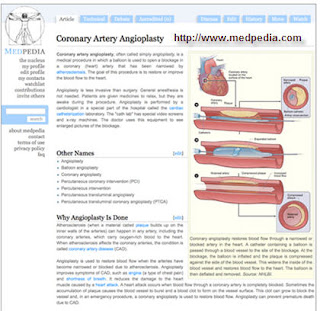
File this one under "Well if you can't beat 'em join em." The Medpedia Project is a collaboration between four leading medical schools, Harvard Medical School, Stanford School of Medicine,  University of Michigan Medical School and the Berkeley School for Public Health.
The project is currently asking for content from health organizations, health professionals and others in the health care industry.
The goal is to provide open source but vetting medical information that would be available to all users around the globe.
According to the web site Medpedia will serve as "a catalog, database and learning tool about health, medicine and the body for doctors, scientists, policymakers, students and citizens that will improve medical literacy worldwide."
As always there are questions and the FAQ does answer some of mine. Unlike Wikipedia the editors will be selected and approved.
From the FAQ's:
One of the questions that hasn't been answered in the FAQ's is whether alternative medical practices such as Acupuncture, Naturopathic medicine, Oriental Medicine practices and similar treatment options would be permitted on wiki.
My List of Questions
A question I have is what is to stop a doctor who has an relationship with a pharmaceutical company to write content in favor of a company that might provide a gratuity to support his/her promotion of certain treatment options? What mechanism is in place to find out if the medical editor's hands have been greased with "special consideration?"
Would the medical community rat 'em out or would it be considered free speech? What would be the controls on the type of content a doctor could or could not post? For example, if the information is counter to what the American Medical Association accepts but the doctor has verifiable information would it be posted or blocked?
My other questions involve reading and comprehension accessibility by average users. What about health care literacy issues? Is it going to be accessible for vision and hearing impaired users? Multiple languages? Video, is there going to be video of certain procedures? Captioned video of course.
Forgive me, I'm greedy. But if this is going to be a global information repository it has a lot of work ahead of them. Some of that work has been paved by web sites like WebMD
What will Medpedia bring to the party and why would library folks use this instead of PubMed or go directly to some of the medical school library/resource web site?
I look forward to having another tool to help folks make health care decisions. I hope it is up to the challenge. Time will tell.
University of Michigan Medical School and the Berkeley School for Public Health.The project is currently asking for content from health organizations, health professionals and others in the health care industry.
The goal is to provide open source but vetting medical information that would be available to all users around the globe.
According to the web site Medpedia will serve as "a catalog, database and learning tool about health, medicine and the body for doctors, scientists, policymakers, students and citizens that will improve medical literacy worldwide."
As always there are questions and the FAQ does answer some of mine. Unlike Wikipedia the editors will be selected and approved.
From the FAQ's:
Only M.D.s, Ph.D.s in a biomedical field and people with medical credentials will be allowed to contribute to Medpedia. Although only M.D.s can edit pages on Medpedia, anyone with an interest in health, medicine and the body is invited to be a Member of the Medpedia professional networking community.The editors will not be paid, it is a voluntary participation. The site eventually hopes to support itself via text advertisements.
One of the questions that hasn't been answered in the FAQ's is whether alternative medical practices such as Acupuncture, Naturopathic medicine, Oriental Medicine practices and similar treatment options would be permitted on wiki.
My List of Questions
A question I have is what is to stop a doctor who has an relationship with a pharmaceutical company to write content in favor of a company that might provide a gratuity to support his/her promotion of certain treatment options? What mechanism is in place to find out if the medical editor's hands have been greased with "special consideration?"
Would the medical community rat 'em out or would it be considered free speech? What would be the controls on the type of content a doctor could or could not post? For example, if the information is counter to what the American Medical Association accepts but the doctor has verifiable information would it be posted or blocked?
My other questions involve reading and comprehension accessibility by average users. What about health care literacy issues? Is it going to be accessible for vision and hearing impaired users? Multiple languages? Video, is there going to be video of certain procedures? Captioned video of course.
Forgive me, I'm greedy. But if this is going to be a global information repository it has a lot of work ahead of them. Some of that work has been paved by web sites like WebMD
What will Medpedia bring to the party and why would library folks use this instead of PubMed or go directly to some of the medical school library/resource web site?
I look forward to having another tool to help folks make health care decisions. I hope it is up to the challenge. Time will tell.
Minggu, 15 Juni 2008
Dr. Loopy on American Idle - Information Resources
Ok, I promise to go outside but I couldn't let this one go. Imagine, if you will a televised competition to find the best resource to help users find information resources.
Will it be Google, Your Uncle or the Librarian?
Watch "Randy", "Paula" and some guy named "Simon" try to figure this out.
Will it be Google, Your Uncle or the Librarian?
Watch "Randy", "Paula" and some guy named "Simon" try to figure this out.
Minggu, 06 April 2008
How Do I Convert Thee, Let Me Count the Ways
In the case of number conversions one size does not fit all. Which is part of the problem. There is no single measurement system that is universally used around the globe. Yes, the Metric system is the predominate system but did you know there are variations?
Living in America tends to metrically separate us from the rest of the world. Did you buy a liter of water or a little more than a quart of water? So in the spirit of moving us metrically forward here are a few web sites to add to your Ready Reference list.
Online Conversions Calculators
The big daddy of them all is Online Conversions. It has all of the basic conversions such as temperature, speed and weight but it also has converters for energy, flow rates, frequency, light and 50,000 other means of transferring data from one system to another.
You type in the value, select the system you want to convert from and the one you want to convert to and you have your answer in a blink of an eye. Which I sure can be measured for speed but I don't know how.
Other sites that perform similar functions include:
Russ Rowlett of the University of North Caroline has a Dictionary of Units of Measurement page. It is kind of like a mini history or number word etymology of different number systems. It is old school in appearance but I now know what a Pfiff is and a Zoll is 1/12 of a fuss.
How Big Is Big?
If you have ever seen The Incredible Shrinking Man you know the answer is relative to your position in the universe. Nikon is a primarily a photography and image processing company. They created a section on their website to give people to get a sense of scale when it comes to size and the relationship to other objects. I suppose it is a way of converting the words we use to describe size and dimension into a graphical representation.
The Universcale is a Flash 6 animation that allows you to see size in relation to other objects. It is a little tricky to get use to but if you click on an object it will give you its size and the relationship to other objects that are larger and smaller. You can also move through a size scale or a measurement scale to compare a Double Decker bus with a jet airplane or a dinosaur.
This would be a great site for children but they would need a little navigational help first.
Living in America tends to metrically separate us from the rest of the world. Did you buy a liter of water or a little more than a quart of water? So in the spirit of moving us metrically forward here are a few web sites to add to your Ready Reference list.
Online Conversions Calculators
The big daddy of them all is Online Conversions. It has all of the basic conversions such as temperature, speed and weight but it also has converters for energy, flow rates, frequency, light and 50,000 other means of transferring data from one system to another.
You type in the value, select the system you want to convert from and the one you want to convert to and you have your answer in a blink of an eye. Which I sure can be measured for speed but I don't know how.
Other sites that perform similar functions include:
- Martindale's Online Calculators with 23,000+ methods of calculations including Agricultural, Gems and Jewry, Medicine Photography, Scientific and many more calculators and converters.
- RefDesk has a Weights and Measure Resource page with links to time zones, periodic tables, currency converters and related topics.
- MegaConverter and Mega Converter2 allows you to perform many of the same type of conversions but there is an added bonus on the resource page. You can download an Excel spreadsheet that has ancient or obsolete measurement systems.
Russ Rowlett of the University of North Caroline has a Dictionary of Units of Measurement page. It is kind of like a mini history or number word etymology of different number systems. It is old school in appearance but I now know what a Pfiff is and a Zoll is 1/12 of a fuss.
How Big Is Big?
If you have ever seen The Incredible Shrinking Man you know the answer is relative to your position in the universe. Nikon is a primarily a photography and image processing company. They created a section on their website to give people to get a sense of scale when it comes to size and the relationship to other objects. I suppose it is a way of converting the words we use to describe size and dimension into a graphical representation.
The Universcale is a Flash 6 animation that allows you to see size in relation to other objects. It is a little tricky to get use to but if you click on an object it will give you its size and the relationship to other objects that are larger and smaller. You can also move through a size scale or a measurement scale to compare a Double Decker bus with a jet airplane or a dinosaur.
This would be a great site for children but they would need a little navigational help first.
Minggu, 09 Maret 2008
Buying Of The President - Financial Information
More Americans are involved in the current election process. I wish it was more intellect than emotion but you gotta start somewhere.

I'm not being cynical. I understand that there is a great need for healing, for a change in national direction and communication across party lines. I don't want a president. I want the best person for the job to step in and honor the full complexity of the job as president.
I keep here a song lyric in my head. "First, I look at the purse." In this case who is funding and supporting the presidential candidates. There are many places to get that information. One of the sites to check out is The Buying of the President. At the site you can learn:
Is The Site Perfect? No.
There needs to be more visual explanations or graphics on where the money flows into and out of the various political entities. I'd want a glossary of definitions as to what is a lobbyist, a PAC, and the various groups that raise money for candidates that are not of the official party machine but are direct pipelines.
It cost next to nothing to put up photos, audio and video; there should be much more of it and captioned with transcripts. If they are indeed networking with college and university students this is a no-brainer. Journalism and Political Science students are waiting for the call. They can help provide documentation and resources.
Perhaps that will occur when the conventions are over.
Who Is Responsible for this Site?
This is a creation of the Center for Public Integrity. Here is how they define themselves:
I'm not being cynical. I understand that there is a great need for healing, for a change in national direction and communication across party lines. I don't want a president. I want the best person for the job to step in and honor the full complexity of the job as president.
I keep here a song lyric in my head. "First, I look at the purse." In this case who is funding and supporting the presidential candidates. There are many places to get that information. One of the sites to check out is The Buying of the President. At the site you can learn:
- Who are the current candidates for president. It is not just Hillary, Barack and John,
- Who are some of the big rollers who have contributed,
- What do you get for (big) money contributions such as access, cabinet posts and other perks,
- Interviews with other investigative journalist who are covering financial facts and fallacies of the campaign,
- and my personal favorite, The Auction Block blog where you can see the movement between lobbyist, fundraising and other money movements of the candidates.
Is The Site Perfect? No.
There needs to be more visual explanations or graphics on where the money flows into and out of the various political entities. I'd want a glossary of definitions as to what is a lobbyist, a PAC, and the various groups that raise money for candidates that are not of the official party machine but are direct pipelines.
It cost next to nothing to put up photos, audio and video; there should be much more of it and captioned with transcripts. If they are indeed networking with college and university students this is a no-brainer. Journalism and Political Science students are waiting for the call. They can help provide documentation and resources.
Perhaps that will occur when the conventions are over.
Who Is Responsible for this Site?
This is a creation of the Center for Public Integrity. Here is how they define themselves:
The Center for Public Integrity is a nonprofit organization dedicated to producing original, responsible investigative journalism on issues of public concern. The Center is non-partisan and non-advocacy. We are committed to transparent and comprehensive reporting both in the United States and around the world.In the coming weeks I'll post other sites that have campaign financial information resources.
Minggu, 10 Februari 2008
A Look At Gazetteers References and Resources
A gazetteer is a geographical dictionary or directory. It can be a list of names or characteristics of a location. Most gazetteer citations have descriptive or statistical information associated with a specific place.
Gazetteers are great for learning about area history, they can be used for genealogy research and as a way to prepare for a vacation or travel plans. This is a brief survey of some of the web based gazetteers.

The Columbia Gazetteer on Bartleby is a good place to start. You can search for information on Canada, United States, Mexico and the Carribean by typing the name of the location.

You can also select from an alphabetical index. This is a year 2000 version of the directory.
It is not to be confused with the subscription services at Columbia Gazetteer Online. This version, published by Columbia University Press, is a complete encyclopedia of geographic locations.

The most bare bones version of an online gazetteer is located at the U.S. Census Bureau Gazetteer.

You can type in the name or the zip code of your location. You will then view results from the 1990 Census about your area.

At this site you can also get the current world population, pictures of national flags, and a variety of statistical information. World Gazetteer data can be displayed in English, Spanish, French and German.
The USGS Planetary Nomenclature is a listing of planet names and their astro-locations. Click a planet, find the region or area and you with see statistical information. You can also download images and topographical maps of the planets as well as links to interactive maps and photography.
Gazetteers are great for learning about area history, they can be used for genealogy research and as a way to prepare for a vacation or travel plans. This is a brief survey of some of the web based gazetteers.
You can also select from an alphabetical index. This is a year 2000 version of the directory.
It is not to be confused with the subscription services at Columbia Gazetteer Online. This version, published by Columbia University Press, is a complete encyclopedia of geographic locations.
At World Gazetteer you can find information on almost every country on the planet. The website gives information on population figures, the original name if available in the original language, latitude and longitude.
At this site you can also get the current world population, pictures of national flags, and a variety of statistical information. World Gazetteer data can be displayed in English, Spanish, French and German.
Gazetteers are not just for earth based locations.

The USGS Planetary Nomenclature is a listing of planet names and their astro-locations. Click a planet, find the region or area and you with see statistical information. You can also download images and topographical maps of the planets as well as links to interactive maps and photography.
Minggu, 27 Januari 2008
Business Librarians - An Overview & Resources
Just as a medical librarian is experienced in locating information on health related topics a business librarian is able to located data on topics such as quarterly earnings in the pet food industry, which database is best for corporate intelligence and just what are "Derivatives"?
Business librarians can be found in academic, public and corporate libraries or as independent contractors.
They will know how to locate information on entrepreneurship, financial literacy; they can dig deep into finding the historical performance of a stock or help you navigate the huge amount of statistical information that the United States produces in a given year.
Even if you have no plans of becoming a librarian the following resources might help you to direct patrons to the people and resources that can be of assistance.
American Library Association Business Reference and Services Section (BRASS) is a section of the References and Users Services Association. The articles and newsletters that I found online talk about issues that specifically relate to this aspect of librarianship. One of the articles that was helpful was the Best of the Business Web Sites which covers web resources such as Accounting and Taxation, Electronic Commerce, Hospitality and International Business.
BRINT - Don't let the amount of information presented on the first page scare you away, it is overwhelming. Think of BRINT as a portal. You locate the term you are researching, say CRM (Customer Relations Management). This will lead you to links on books, articles, research, blogs and other resources.
BRINT helps to narrow down business related search topics. It basically constructs the search term for you and then leads you to the results. Caution: some of the search engines listed at the bottom of the pages have been discontinued, i.e. Teoma was acquired by Ask.com.
Business Librarians Social Networking at Ning. Laurie Bridges created this social network for academic, public and other folks who work with this specialized knowledge set.
Business librarians can be found in academic, public and corporate libraries or as independent contractors.
They will know how to locate information on entrepreneurship, financial literacy; they can dig deep into finding the historical performance of a stock or help you navigate the huge amount of statistical information that the United States produces in a given year.
Even if you have no plans of becoming a librarian the following resources might help you to direct patrons to the people and resources that can be of assistance.
American Library Association Business Reference and Services Section (BRASS) is a section of the References and Users Services Association. The articles and newsletters that I found online talk about issues that specifically relate to this aspect of librarianship. One of the articles that was helpful was the Best of the Business Web Sites which covers web resources such as Accounting and Taxation, Electronic Commerce, Hospitality and International Business.
BRINT - Don't let the amount of information presented on the first page scare you away, it is overwhelming. Think of BRINT as a portal. You locate the term you are researching, say CRM (Customer Relations Management). This will lead you to links on books, articles, research, blogs and other resources.
BRINT helps to narrow down business related search topics. It basically constructs the search term for you and then leads you to the results. Caution: some of the search engines listed at the bottom of the pages have been discontinued, i.e. Teoma was acquired by Ask.com.
Business Librarians Social Networking at Ning. Laurie Bridges created this social network for academic, public and other folks who work with this specialized knowledge set.
Langganan:
Postingan (Atom)