Halaman

Tampilkan postingan dengan label cataloging. Tampilkan semua postingan

Kamis, 28 Juli 2011

Quick Look At the Helioid Search Engine

I have friends and relations that kinda sorta know how to use Google. They don't know about Bing, Ask.com or the other search engines that are available. Then again, a lot of folks believe that Facebook is a search engine.

I am restricting how many semantic wars I can handle in a day.

You, on the other hand, should know about the diversity of options you have when it comes to web search engines. This is a new one called Helioid.

Helioid Search Engine
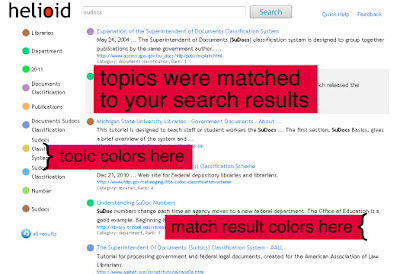
The above screen capture is from the Quick Help at the web site. Basically you can type in your search term/keyword and not only do you get a list of viable links you get a side category of topics that are color coded to your search results.

I did a test search using SuDocs (The Superintendent of Documents classification system) These are the topics area that were visible on the left side of the screen:
  • Libraries
  • Department
  • 2011
  • Document Classification
  • Publications
  • Documents SuDocs Classifications
  • SuDocs Classification System
  • SuDocs Classification
  • Number
  • SuDocs
Not perfect but not too bad for a general purpose search engine. 2011 refers to SuDoc links that have a 2011 date of publication. Number refers to the word "number" in relation to the word "SuDocs."

Now if I want to see only the SuDocs Classification System items I click on the yellow circle and I only see the four links that match.

I like that.

Helioid is new so there are thing that are missing like being about to type in a search date range or selecting .edu or other specific domains. That will come in time.

So I encourage you to check it out and offer feedback to the Developers.

Kamis, 02 September 2010

Infopeople's online course "Basic Cataloging andClassification"

Please note: Infopeople is applying for LSSC (Library Support Staff Certification) certification for this course.

Title: Basic Cataloging and Classification

Format: Online Dates: October 12 – November 8, 2010

To register for this workshop: Use the online registration form at
http://infopeople.org/workshop/461

Fee: $75 for those in the California library community and Infopeople Partners, $150 for all others.

Are you looking for an opportunity to learn basic library cataloging and classification? Update your knowledge with new developments in the field? If so, this online course is for you.

Through practical information and hands-on exercises, you will gain an understanding of cataloging practices, rules, and tools, as well as the nuts and bolts of copy cataloging. New developments―such as Resource Description and Access (RDA), the Library of Congress genre/form headings project, and Book Industry Standards and Communications (BISAC) subject headings―will be discussed as well. Tips on copy cataloging of newly emerging formats, such as e-books, graphic novels, and download media will be offered.

At the end of four weeks you will feel comfortable with the basics of cataloging, classification, and MARC records and be ready to begin copy cataloging items in a variety of formats.

Course Description: This four-week online course will provide an overview of library cataloging and classification and prepare you to do copy cataloging. Through reading materials, short video presentations, an online forum, and individual exercises, you will gain knowledge of basic cataloging rules and tools, commonly used controlled vocabularies, the Dewey Decimal Classification system, and MARC21 format. Applying this knowledge, you will be able to decode MARC bibliographic records and perform basic copy cataloging. The course will briefly discuss some new developments in cataloging rules and practices.

During the course, you will be doing assignments and taking quizzes. You will also participate in discussion forums and online meetings as part of the online learning process.

Preliminary Course Outline: Using your web browser and your Internet connection, you will log in to the Infopeople online learning site and complete the following learning modules:

· Week 1: What Is Cataloging?
Purpose of cataloging
Elements of cataloging: descriptive cataloging, subject cataloging, and classification
General cataloging methods and cooperative cataloging
Introduction to AACR2r and ISBD
Introduction to RDA
· Week 2: Introduction to Library of Congress Subject Headings (LCSH) and Dewey Decimal Classification (DDC)
What is LCSH?
Other controlled vocabularies – Sears, LC Genre/Form Headings, LC Children's Subject Headings, Book Industry Standards and Communications (BISAC) Subject Headings
What is DDC?
Relationship between the subject heading and a Dewey number
Verifying a DDC number for the item in hand
· Week 3: MARC Formats
What is MARC?
Elements of MARC records
Types of MARC bibliographic formats
Summary of commonly used MARC fields for bibliographic data
· Week 4: Basic Copy Cataloging
Tasks of copy cataloging
Which cataloging record to use?
Essential MARC fields to verify
Tips on copy cataloging e-books, graphic novels, and download media

Instructor: Xiaoli Li. Having worked in both public and academic libraries, Xiaoli Li has a wide range of experience with cataloging. She is an active advocate for continuing education and a trainer for "Cataloging for the 21st Century," a Library of Congress initiative. She has made numerous presentations and authored several journal articles on serials control. She chaired OCLC Post Pinyin Conversion Cleanup Project and planed several major projects for the libraries where she has worked, including Yale University Libraries, University of Washington Libraries, and most currently UC Davis.

Time required: To complete this course, you can expect to spend 2 to 2½ hours per week, with options for further study and application. You can work on each module at your own pace, at any hour of the day or night. However, it is recommended that you complete each week's assignments within that week to stay in sync with other learners.

Who Should Take This Course: Anyone from the library community with an interest in learning the basics of library cataloging and classification. This course is particularly focused on the needs of public library staff newly assigned to copy cataloging tasks. Those taking the course must have a working knowledge of the integrated library system (ILS) used in their libraries. The instructor will provide more extensive work with the Dewey Decimal Classification system than with alternatives, but Library of Congress and other classification systems currently in use will be discussed as well.

Online Learning Details and System Requirements may be found athttp://www.infopeople.org/training/learning_details.html.

After the official end date for the course, the instructor will be available for limited consultation and support for two more weeks, and the course material will stay up for an additional two weeks after that. These extra weeks give those who have fallen behind time to work independently to complete the course.

If you would like to subscribe via RSS and be notified whenever new Infopeople training events are available, you can use these links:
**For new on-ground or online workshops: http://infopeople.org/workshop/rss
**For new podcasts: http://feeds.feedburner.com/InfopeoplePodcasts

Other Logistics:

To view a complete list of Infopeople workshops and for general information about Infopeople Training opportunities, go to the main Infopeople Workshops page at http://infopeople.org/workshop

If you have questions about registration, please contact Linda Rodenspiel, the Infopeople Project Assistant, at assist@infopeople.org or by phone at 650-578-9685.
Rabu, 16 Juni 2010

More Library Whimsy - Librarians Do Gaga

Catalogers have got the beat. Yes, Lady Gaga influence has hit the reference zone. This is a bit of fun from the University of Washington's Information School.


Sarah Watcher has got the skivvy on how the video came together. You can also get the lyrics to the song on her blog. Sarah will be getting her masters in library and information science in June of 2010.

Selasa, 04 Mei 2010

Library of Congress to preserve Twitter posts

Library of Congress to preserve Twitter posts
(AP) – Apr 14, 2010
SAN FRANCISCO — That Twitter message you just posted about your ham sandwich might now become part of history.
Twitter is donating its archives of tweets to the Library of Congress, going back to the first one posted by co-founder Jack Dorsey on March 21, 2006. It wasn't a profound moment, and Dorsey didn't come close to Twitter's 140-character limit for messages. He simply posted "Jack," according to the Library of Congress' archives.
Twitter and the Library of Congress announced their partnership Wednesday.
The Library of Congress wants to store tweets to give researchers a better way to revisit discussions of significant events, including the tweets that occurred after President Obama's election in 2008, during the protests in Iran last year and the earthquakes in Haiti and elsewhere this year.
Only tweets meant for public viewing will be available, though. Accounts with more restrictive privacy settings won't be included.
There's also another limitation: Twitter said the Library of Congress won't be able to offer access to specific tweets until six months after they're posted. That means the Library of Congress' archive will always been missing billions of tweets, based on the 55 million daily tweets that Twitter says it's now processing.
In a separate deal announced Wednesday, Internet search leader Google also began to draw upon tweeting history with a new tool that will allow people to sift through Twitter messages about specific topics by day, month or year. Only tweets going back to Feb. 11 of this year will be available initially, but Google eventually expects to gain access to all the messages dating back to Twitter's birth.
Copyright © 2010 The Associated Press. All rights reserved.

Minggu, 28 Juni 2009

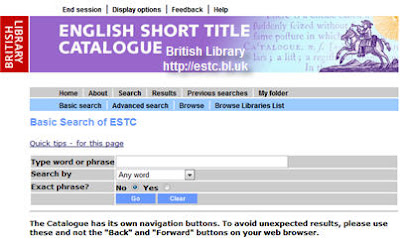
English Short Title Catalogue at the British Library

At this section of the British Library website you can locate titles for books published between 1473 and 1800. If the material was published in the UK or its possessions, Colonial America or any place else on the planet, and it was printed in English, it very well might be listed in this database.

English Short Title CatalogueNow short title does not refer to the length of the actual name of the book. As you can see from the example below, titles could be quiet descriptive:


My understanding is that it refers to limited or special publications produced quickly. I'm thinking like pamphlets, broadsheets and the early equivalents of instant publishing.

As you can see, you can view the records in a variety of formats such as a three line summary listing, full MARC tags, or which institution has the actual document.

This is a good resource if you are researching ephemeral publications that give a sense of time and place.

It is also valuable if you want to brush up on your MARC skills if it has been long time since you have sweated a MARC code. Check it out.

Jumat, 20 Maret 2009

Volunteer Opportunities at Pasadena (CA) Central Library

The main branch needs volunteer assistance with the Pasadena Community Calendar and the online database AccessPasadena.net

What is involved:
  • Data entry,
  • Online research and verification,
  • Customer service.
Provides an opportunity to gain inside knowledge of the various facets of public libraries.

Required skills:
  • Effective computer skills: software, browser and typing;
  • Effective communication skills: telephone and e-mail.
Recommended preparation
  • Completion of: LIB 1, 10A, Bit25/CIS 1, LIB 102 (Reference) and LIB 105A (Cataloging)
Requirements:
  • 5 hours per week, Monday- Friday 8:30am - 4:30pm. Flexible schedule.
  • Minimum commitment of 4 months.
To apply, contact:

Aracely Sustaita
Technology & Information Systems
Pasadena Public Library / Glendale Public Library
626.744.4254 - phone
626.449.2165 - fax

Sabtu, 03 Januari 2009

Uncontrolled Vocabulary Library Podcasts

Uncontrolled Vocabulary is a library podcast by and for librarians and the people that hope to work for them.


The podcast covers a wide range of topics such as:
  • Episode #62 Library students bill of rights that was generated by a Tame The Web guest post by Char Booth,
  • Episode #63 What Happening to Library Blogs in reference to Pegasus Library's concern that folks are burning out or Tweet happy,
  • Episode #66 On how a parent was concerned when he noticed that the new public school plans being did not include space for an actual school library.
There is plenty in the archives to feast on and you can listen on-line or download the program into your media players that accept the .mp3 format.

Rabu, 22 Oktober 2008

Employment Bonaza - Check Out These LT Jobs

Let's get right to it starting with California Institute of Technology (CalTech). There are two positions: LIBRARY CLERK and PROJECT ARCHIVIST

Library Clerk - CIT15019MA - CIT15019MA
Requisition Number: CIT15019MA
Job Title: LIBRARY CLERK Department
Name: Library - Circulation Department Job Category/Family: Library
Job Discipline & Career Level: Library Support / Assistant Salary
Grade: 37 Anticipated Hiring Range:$10.00 per hour Date Posted:
10/20/08 Summary Under direct supervision, provide support by performing a variety of general to paraprofessional clerical, technical and customer service duties utilizing automated library systems Institute-wide.

Project Archivist (Temp PT) - Archives - CIT14996LF - CIT14996LF
Requisition Number: CIT14996LF
Job Title: PROJECT ARCHIVIST
Department Name: Archives Job Category/Family: General Administration
Job Discipline & Career Level: Archives Services - IC / Assistant
Salary Grade: 40 Date Posted: 10/20/08 Summary Part-time temporary professional 4-6 month position (20 hours per week) in the Caltech Archives arranging and describing several large complex manuscript collections to the history of genetics. Works under the general supervision of one of the Senior Archivists.

To apply for these positions, please visit:
http://www.recruitingcenter.net/clients/CALTECH/publicjobs

Part-Time Cataloger

Next there is Library Associates Companies (LAC) is seeking a part-time cataloger for a Company located in Pasadena, California that deals with food and nutrition. Projected hours are 8 to 16 hour per week or a day and a half weekly.

RESPONSIBILITIES:

Primarily copy cataloging of books, periodicals and media dealing with food, baking, cooking, law, nutrition.

QUALIFICATIONS:
  • Previous cataloging experience using OCLC, MARC records, AACR2.
  • Experience using an Integrated Library System (ILS)
  • Catalog training in an accredited Library School or a College offering a Library Technical degree
To APPLY:

Please send resume and cover letter to the attention of Patty De Anda at, jobs@libraryassociates.com. Please use "Cataloger - #1092" as the subject line of your email.

Experienced Cataloger

Also at LAC is seeking an experienced Cataloger for a prestigious Company located in Irvine, California. The position requires the cataloging of a backlog of materials, primarily books.

This is a full-time position until the backlog is complete and the position will then become part-time to keep the collection updated and for the cataloging of new acquisitions.

The items to be cataloged are primarily in one office but additional items will be required for pick-up in a private residence close to the main office. Reimbursement for work-related travel will be provided.

Full-time hours to begin are from 8:30 to 5:30, Monday-Friday.

RESPONSIBILITIES:

Cataloging of a variety of books, mainly History, Travel, Ancient Christian Commentaries, Art Books, Religious materials, Map Books, Novels and general Non-Fiction.

REQUIREMENTS:
  • MLIS is preferred but a BA degree and extensive cataloging experience will be considered.
  • Extensive use and knowledge of cataloging systems, including Dewey Decimal, Library of Congress, AARC2, LC subject headings, MARC records, etc.
  • Excellent work habits, reliability and the ability to be self-directed.
  • Must be able to drive to nearby residence for pick-up ofmaterials to be cataloged.
TO APPLY:

Email resume as a Word attachment to Joanne Schwarz, jschwarz@libraryassociates.com.
Please use "Cataloger - Private Collection - #1042" as the subject line of your email submission

Library Associates Companies is an Equal Opportunity/Affirmative Action employer that values diversity in the workforce.

Kamis, 25 September 2008

University of the West Library Chinese Cataloging Internship

The University of the West Library has an internship opportunity for students who are interested on learning Chinese cataloging. Internships for credit require enrollment in LIB 106 Field Practice and 6 additional units at PCC.

If you are interested please contact:

Ling-Ling Kuo, Librarian, University of the West Library
1409 Walnut Grove Ave, Rosemead, CA
(626) 571-8811 x. 135

Kamis, 05 Juni 2008

More 105 Cataloging Help - Kinda, Sorta

Saturday. Friday is before Saturday and Saturday is the day of the Cataloging Final. To those about to take the test we salute you and are glad we are on the other side of it.

I know I was pitiful. I was mumbling AACR2 left and right. That blankety blank punctuation drove me nuts. I still can see my classmates. Binders full of notes and marked up AACR2. We came prepared but most of us had our doubts of seeing daylight ever again. People shaking their heads in despair, others kept the mantra going, "It is ok, it will be alright."

But I have to tell you, that stuff comes in handy in ways you do not expect. I am very glad that I took the class. But I was sweating bullets each and every week.

The Short Version:
  • Review Your Notes, Exam Questions and AACR2
  • Tell your loved ones to bug off - this is serious business.
  • Get some sleep, eat a great dinner and sleep with your (paper) notebook.
Other Resources:

In addition to the other cataloging links that you can find by looking for the word cataloging in the sidebar, I have a few more hopefully helpful study tips.

There is a OSU Power Point presentation that is a review of AACR2 Chapter 12. If you can't view or download PPT's you can look at an HTML generated copy of Chapter 12.

I was thinking that there might be a few resources at Google Books that could be helpful. Like for example the meaning of the word "imprint"? The Dictionary of Library and Information Science might be of interest to you, especially page 351.

This is a partial preview. The whole book is not available. But you might find what you need to help you understand what bibliographic control is which may or may not be on page 69.

I did find some library specific glossaries, AACR2 Definition of Terms, An AACR2 record description list and Abbreviations for Place of Publication

Good luck and deep breaths.

Minggu, 04 Mei 2008

Cataloging SOS - Cataloging Reference Books

AACR2 is many things but easy reading it is not. It is not too late to find more humane help in understanding cataloging and classification.

Libraries Unlimited has a number of books and workbooks on cataloging/classification.

IntroC&C
I think this was the one that we flipped through at the California Library Convention in Long Beach.

Closer to home, Cataloging & Classification for Library Technicians is on the third floor of the library - 025.3 K 4, 2001 or if somebody beats you to it you can order at Amazon.com

Cataloging & Classification for Library Technicians

Descriptive Cataloging, this one will be good for both 105A and 105B You can find it at Amazon.com or Powell's Books


Cataloging Book - Learn Descriptive Cataloging

Remember, if you are short on cash don't hesitate to do the WorldCat thing, somebody, somewhere has got these books.

Cataloging SOS - Tag of the Month Club

Yes indeed, it is that time of year when Library 105 students go into a cold sweat. Ten or more weeks of cataloging goodness will do that to you. It is not just learning how to write and understand the concepts of MARC, it is that pesky punctuation that just kills the majority of the class.

300 Tag of the Month

I know, one doggone period in the wrong place and boom, there goes your grade. No worries. There is help. Check out Follett Software Company's Tag of the Month.

It goes into a description of what the tag is, the reason for the tag and most important how to punctuate the sucker.

Now if there is a discrepancy between what the Tag of the Month suggests and what Dawn says the punctuation of the tag is don't be a dope, go with Dawn! But at least this will help you to understand the syntax of the tag in question. Don't forget about spacing, that counts too but this will help you remember what goes where and why.

Background Information for Non-Library Folks

For those visiting from other parts of the blogosphere we ask for your sympathy and good wishes for every library cataloging student in the world. There is a whole bunch of technical stuff that happens long before you get your hot little hands on a book or library material.

One of the skills those of us who are interested in library work have to know (or should know) is Machine-Readable Cataloging or MARC. It is a process where the material, let say a book is described by a number of data points such as the name of the author, the type of material, its physical dimensions (if any) the publisher and a bunch of other stuff.

All of this happens in the background so when you step up to the terminal or log on from home you put in what you know about a book and bada-bing, you get results based on your search request.

There is no artificial intelligence at work - this is organic human brain power generated data. Why? Because every book, DVD, CD, Sheet Music, photograph, mp3 file, video or other materials is unique. Way too many variables for a (current) software program to account for automatic entry. The picture above is showing an example of a MARC 300 tag which defines a material by its physical description depending on what kind of object it is. .

Minggu, 13 April 2008

Music Cataloging Resources

You walk into a room. There are hundreds of boxes of vinyl recordings before you. You open the first box and see this 45 record:


Originally uploaded by me1vinsparks

How do you catalog this record? You've taken the cataloging class but that was primarily for books. The concepts are the same but you want to review the resources for cataloging music.

AACR2 Resources

Training Materials for Music Cataloging
. In 1995 Ian Fairclough put together this list of cataloging study tips that can be reviewed. It gives you the sections of AACR2 to review and study for music cataloging. Please understand that this is an old list and does not address music formats such as MP3, FLAC or DRM issues.

From the University of Buffalo another option is to take a look at the Sound Recording Workshop Handouts created by Jay Weitz. It seems to be a Power Point presentation that was converted to images but it is really helpful in focusing on the areas you will need to extract information from and how to do it.

MARC Resources

Penn State University Sound Recording MARC Fixed Field Cheat Sheet - This will give you an idea of how to find or prep music MARC codes. This cheat sheet is for the Unicom system, you would have to adapt it to Voyager or other software programs.

Yale University Library has a Voyager based Physical Description Codes for Sound Recordings
that you can use to make sure that you are on the correct path in Voyager. You should also view the Fixed Fields for Sound Recording Chart.

Other Resources:

Music Catalogers ListServ (MOUG) - if you really want to know more about music cataloging, OCLC issues and the day to day realities of quantifying that grove.

Authority Tools for Audiovisual and Music Catalogers: An Annotated List of Useful Resources

Music Cataloging At Yale - Long list of websites and resources for a wide variety of music cataloging needs.

Just for Fun (Kinda)

Jason Poole created a video about his informal survey with librarians on how they classified music. It is music and text, no vocals. There is also a brief introduction to the ANSCR music classification system.


Minggu, 16 Maret 2008

Library Support Survey - Participation Request

A while back I wrote about a proposed library support certification program that is being developed.

For those of you that are working as library support staff, pages, techs, or assistants this is an opportunity to participate in the Library Support Staff Competencies Survey that is trying to quantify the tasks and duties that library staff personnel are involved with on a daily basis.

The survey will take about 40 minutes to complete, however you can select the parts of the survey that you have specific knowledge, skills or direct experience.

Minggu, 10 Februari 2008

University of LaVern Law School - Cataloging Assistant

The University of La Verne has an opening for a Cataloging Assistant in the College of Law Library. The position is responsible for creation & maintenance of bibliographic records and serials control.

Primary duties for this position include:
  • assisting the Cataloger with copy cataloging of the Law Library’s materials in all formats
  • maintaining serial holdings including the creation of MARC holdings, title changes, etc.
  • performing routine database maintenance on the library’s bibliographic holdings
  • placing library’s holdings in OCLC’s Union List and maintaining the database according to current cataloging standards and practices and other duties as required.
This position requires an Associates degree (A.A.) in Library Technology with coursework in cataloging or equivalent experience.

You can obtain a MS Word or Adobe PDF application by visiting the Classified Application Procedures page. To apply, please send a complete application in Word or PDF format to: jobs@ulv.edu, or mail to Human Resources, University of La Verne, 1950 Third Street, La Verne, CA 91750. Or you may FAX your application to: (909) 392-2791.

Minggu, 28 Oktober 2007

Library of Congress Classifiction Tutorials

Yes, learning the Library of Congress Classification system is not for the faint of heart. Fortunately there are some online resources that you can use to get a handle on how things are done in LC land.

The LC Classification system is a subject based classification system using alphabets and numbers to create subdivisions of a subject.

Classification Number Anatomy

Dennison University has a visual page that shows the construction of an LC number.

Another place to check is Tarleton State University Library has a clear tutorial page that explains how the call numbers are built.

If you have the current version of Java running you can access a Java based slide show on how the numbers function in the real world. First thing you will learn is that "Nothing comes before something" and the second thing is "single letters come before double letters." There is a quiz at the end to test your comprehension.

Theory Based Tutorials


Tulane University Howard Tilton LC Informal Notes page talks about the features of LC, how it was constructed and some of the quirk inherent in the system.

Colorado State University goes into a bit more detail on how the call numbers are constructed. The first section has information on the classification scheme and the second section describes how to find the book on the shelf.

University of Michigan Libraries Understanding Library of Congress Call Numbers combines the anatomy approach with an explanation of how to read the number. This is a downloadabled .pdf document.

And finally thanks to Lisa The Librarian's blog there is a complete demo tutorial on shelving and reading LC numbers at the LibraryU website. Look for the link "Demo" on the left side of the screen.

Of course you should visit the Library of Congress Classification Outline page where you can download specific sections of the classification system and observe how the system is constructed and spend time exploring Classification Web.

Minggu, 14 Oktober 2007

Dewey Decimal System - All Dewey All The Time

If you find yourself working in a public library chances are good that it will use the Dewey Decimal System. Melvil Dewey is certainly represented on the web and in the blogosphere.

The following places of interest are a quick look at some of the resources available to help you learn and understand about the classification system. If you are taking Library 105B you are hip deep in the Dewey so hopefully I can dig out additional resources for the class.

The official Dewey site Online Learning Computer Center (OCLC) contain a gateway to the world of classification. You can download a copy of Introduction of Dewey Decimal Classification. In 37 pages it will give you the history, the classification schedules and the beginning steps on how to determine a subject, Notation, field of study and working with schedules and tables.

You will also want to check out the glossary of Dewey terms. Students in certain LT classes have access to Web Dewey but if you would like to get a head start on how to use the Web Dewey feature you can view a Power Point tutorial.

Outside of OCLC another place you want to visit is the Dewey Blog, edited by Johnathan Furner and the DDC team. If you can think it there is (or will be) a Dewey number for it. The blog represents life as viewed by the DDC. One of the entry that had me blinking was the classification of the toys and lead problems that have been in the news.

They go through the process of how this topic has been classified and what they do when there is not an exact match in the classification system. It is also a good opportunity to observe how a DDC "built" numbers are constructed.

Not every public library has Dewey, in fact there are a few that stopped using Dewey numbers such as the one in Arizona. They will arrange books by topic instead.

This has generated a lot of posts. Daniel DeStefano isn't crazy about the idea. A Library By Any Other name blog suggest that one of the problems with patrons finding books is that there isn't the right kind of signs or visual cues that would make it clear that where to find the history book.

Not all folks hate the idea of pitching Dewey - some folks like Shelly from A View From Here mention that maybe there could be a merger between the bookstore model and the traditional library classification systems.

Minggu, 16 September 2007

Superintendent of Documents Classification System

If you want to locate federal publication documents you don't need to learn the Superintendent of Documents Classification System (SuDocs). The Government Printing Office Catalog of U.S. Government Publications allows you to type in keyword or perform advanced searches.

If you plan on working in a federal library, an academic depository library or you need to access U.S. government produced documents on a regular basis then you might need to learn this classification system.

SuDocs will make it easier to understand which agency is publishing the document and when it was created. SuDocs is a system based on:
  • the agency or department that created the document
  • the sub-level of that agency (if any)
  • the series designation (if any)
  • the number that designates the title of the publication
  • the date of publication.
For example: HE20.2:H81 translates to Health and Human Services Department Public Health Services publication entitled National Household Survey on Drug Abuse.

To learn More About SuDoc Classification

Kamis, 12 Juli 2007

Library Associates Need A Part-Time Cataloger

I got job lead this via the COLT Yahoo group - Library Associates is seeking folks for a temporary part-time 20 hours Cataloger at a Pasadena library.

Responsibilities:
  • Copy and original cataloging of adult books, federal and state documents, spoken and music CDs, DVD and serial titles
  • Other duties as assigned.
Qualifications:
  • Familiarity with DDC, ASCR, SuDoc and/or California document classification or a combination of DDC with one of the specialized classification schemes;
  • Experience cataloging sound recordings (music CDs and spoken CDs), serials (travel guides, directory, annuals);
  • Experience copy cataloging foreign language books;
  • Experience cataloging DVDs
You should have at least two to three years experience in Cataloging and prior experience working in a public library is a plus.

If you are interested you can e-mail Patty De Anda with your resume with a cc to Joanne Schwarz. Please use the job title as the subject. For more information about Library Associates - a library placement firm please visit http://www.libraryassociates.com/index.html

Jumat, 15 Juni 2007

Cataloging Help for the Hopeless - Library 105A Assistance

Ok, there is hope. It is just that before an exam I see the darkness before the dawn.

We'll do fine. I think. So this is just a recap and additional sources to check out and compare what we have learned and what we might have to back fill on for the exam.