Halaman

Tampilkan postingan dengan label information literacy. Tampilkan semua postingan

Sabtu, 19 Mei 2012

The Data Journalism Handbook

There are all kinds of ways to find information. What do you do when you find it? Or perhaps there is so much of it that it requires a different approach to share the main points of the sources.

The Data Journalism Handbook is a guide written by journalists to help other journalists and people who need to deal with large amounts of information to find a way to get to the good stuff and make it visible.


There is a free web version and a paper version that will be published some time this year. In the web version you can select the chapter that most meets your needs at the moment.

The books focus is from the point of view of someone in the United Kingdom but who wants to always search American centric information anyway.

Chapters that might have an appeal to library students include:

  • A Five Minute Field Guide - suggested methods to organize your thoughts and a listing of data sources that could provide support to hard to answer questions. Some of the sources cited are the Guardian's World Data Bank, Project Wombat and ScraperWiki.
  • Basic Steps In Working with Data - how to ask the right questions and find the answers.
  • Designing with Data - because when you find it you have to do something with it. How do you present the result of your search without distorting the intended meaning?
This is a good resource for the old kit bag

Rabu, 08 September 2010

International Literacy Day


Did you know that September 8 is International Literacy Day? Neither did I till very recently. One may think literacy isn't that huge of an issue but according to the International Reading Association, " More than 780 million of the world’s adults (nearly two-thirds of whom are women) do not know how to read or write, and between 94 and 115 million children lack access to education." Without literacy, simple things as such reading a label, filling out a job application, even getting around can be virtually impossible.

Want to get more involved? Check out the International Reading Association, ProLiteracy or even your local library. Often times libraries have literacy programs which they can always use volunteers for. See the Southern California Library Literacy Program website for a list of libraries. Even if you don't see a library listed near you, it's still possible there may be a literacy program there, so ask. For example, I live in Monrovia and even though they are not on the SCLLP list, I know they have a literacy program from looking on their website in the past. Last but not least, ALA (American Library Association) has lots of information on literacy from children's to adult literacy. Check out the Office for Literacy and Outreach.

Feel you just don't have the time, then take the time to sign the ProLiteracy and Literacy Powerline's Declaration for the Right to Literacy scroll which will be presented to President Obama.

Minggu, 01 Maret 2009

UNT/CSUN Information Meeting At Pasadena Library

You might recall Jared gave a recap of his experience attending a information session about the University of North Texas conducting a School of Library and Information Science program on the campus of California State University, Northridge. Dr. Philip Turner will give the presentation.


This is a distance learning program. Most of the classes and communication will be conducted via the Internet. The classroom meetings and exams will take place on the campus of CSUN. This program is restricted to Los Angeles/Southern California area students who can attended the CSUN class sessions. You can view the program flyer for more details.

This is a reminder for those of you considering an online library school program that they will be a information meeting March 9, 2009 at Pasadena Central Library, Pasadena, CA at 3 p.m. The address is:

Pasadena Central Library
285 E. Walnut Street
Pasadena, CA

There will be also be an information meeting the same day Buena Vista Library in Burbank, CA. The starting time for the Burbank information meeting is 7 p.m.

Buena Vista Library
300 N. Buena Vista
Burbank, CA

For more information about the Los Angeles area specific distance learning program you can visit the University of North Texas information page. You can also visit the main library school program site.

Sabtu, 03 Januari 2009

Children's Book, Reference and Nonfiction Blog

I used to know kid books because I was a kid. I'm a little older now so I need help to find materials for the young ones. There are a lot more questions around than when I was a kid and I had a bunch even then.

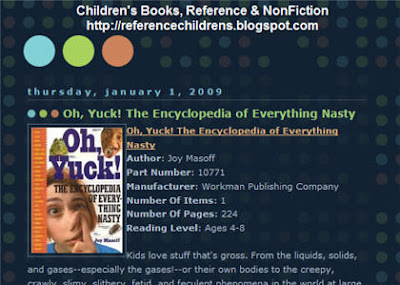
I happened to find this blog, Children Books, Reference and Nonfiction blog about books, reference materials and non-fiction for young people.

Book-Oh Yuck, the Encyclopedia of Everything Nasty
This is a relatively new blog but Donna has been busy stock it with books that curious minds need to answer their questions. I'll keep an eye out for it and see what new items there are in kid references.

Rabu, 05 September 2007

Information Literacy Resources For Time Staved Students

This is an additional listing of web based information literacy resources. Information literacy has many people writing, talking and producing videos on this topic.

For example, the tutorial at the City University of New York incorporates traditional writing skills (for presentations, reports and papers) and those skills necessary to evaluate the information found on the Internet.

Stanford University's Stanford Key to Information Literacy is similar but includes a self quiz to help you check your comprehension. This tutorial is based for Stanford students but there is good stuff to be found, particularly in the Use Criteria section.

Speaking of which, there is a search engine that only allows content from authoritative sources. The Undergraduate Search Engine was created by volunteer librarians for use by freshman and sophomore students.

Librarian bloggers certainly have much to say about the topic. You should take a peak at Michael Lorenzen's work at The Informational Literacy Land of Confusion, he writes about library and non-library related issues with info literacy.

Information Literacy Weblog connects the topics with current world connections such as social networking, Second Life (how should librarians present themselves in Second Life) and work-based learning.

You don't necessarily have to read or work through modules to understand information literacy. On YouTube there are a number of videos contributing their two cents about the topic.
This is just a small sample of what is out there. Dive in and drink deep.